Layered Lighting Design for a Living Room: A UK Guide to Ambient, Task and Accent Light
Most UK living rooms are lit by one thing: a single pendant hanging from the centre of the ceiling. Switch it on and the whole room gets the same flat, downward light. Switch it off and the room is dark. There is no middle setting, no reading light that does not flood the room, and no soft evening light for conversation. It is not a fault in the house. It is how most British homes were wired, often with one ceiling rose in the middle of the room, one or two switched sockets, and ceiling heights of about 2.4 metres that leave little room for drama overhead.
Layered lighting is the fix, and it does not mean buying more lights for the sake of it. It means giving each light a job, putting lights at different heights, and putting them on separate switches so you can choose the combination that suits what you are doing. A living room has to do more jobs than any other room in the house. It is where you read, watch television, talk, work for an hour, entertain friends, and wind down before bed. One light cannot do all of that well. Three layers, used thoughtfully, can.
This guide explains the three layers in plain terms, how they work in the rooms British homes actually have, what to do when you cannot rewire, which bulb colour to choose, and how to plan a complete scheme for a typical living room, with a worked example at the end. It is about lighting design, not electrical work. Where a job needs a new circuit, a new switch or work in a ceiling, that is a job for a qualified electrician, and this guide says so rather than pretending otherwise.
The Three Layers, in Plain Terms
Think of the layers as three different kinds of light, not three different kinds of fitting. The same fitting can sometimes do more than one job, but the job is what matters.
Ambient light is the general light that lets you move around the room safely and see its shape. It is the background level, soft and even, and it should not be the brightest light in the room. In a living room, ambient light often comes from a ceiling pendant with a shade that spreads light, from wall lights that wash light up and down the wall, or from a pair of floor lamps that bounce light off a pale ceiling. Its job is orientation, not detail. You should be able to walk in, find a seat, and see the whole room without squinting and without a pool of harsh light in the middle and darkness at the edges.
Task light is focused light for something you are actually doing. Reading is the classic living room task, but so are sewing, doing a crossword, working on a laptop for an hour, or helping a child with homework at the coffee table. Task light sits close to the task, at or near seated height, and it comes from the side or from behind the shoulder, not from directly overhead. A floor lamp beside a reading chair, a table lamp on a side table next to the sofa, or a small adjustable lamp on a desk in the corner are all task lights. The test is simple: can you read comfortably in that seat without turning on the main ceiling light and without a shadow falling across the page?
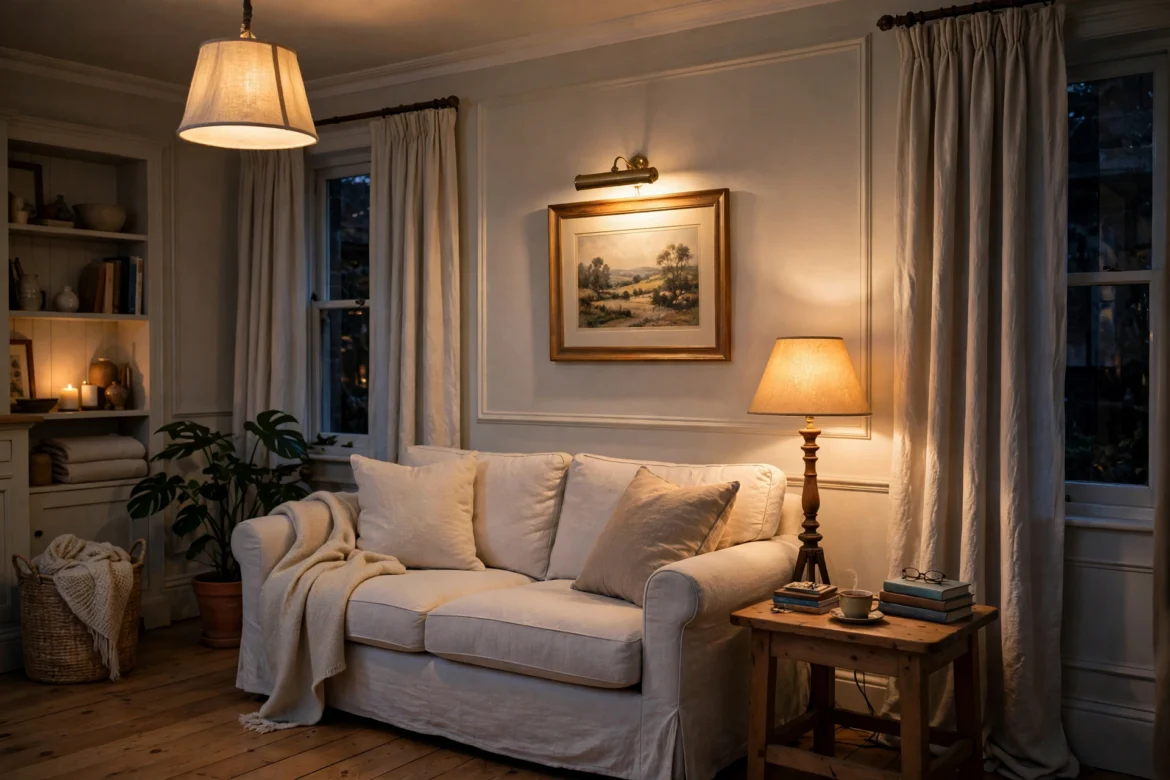
Accent light is light that is there to look at, or rather to make something else worth looking at. A picture light over a framed print, a small spot aimed at a fireplace or a textured brick chimney breast, a strip of light inside an alcove shelf, or an uplight behind a plant all count as accent light. It lights walls and objects rather than people, and it is what gives a room depth after dark. Without accent light, a room lit only from above can look flat, because every surface gets the same light. With one or two well placed accent lights, the eye has places to rest, dark corners disappear without being flooded, and the room looks finished rather than merely lit.
A useful rule is that most living rooms feel balanced with five to seven light sources in total, spread across different heights, but not all switched on at once. That sounds like a lot until you count what you probably already have: one ceiling light, one or two lamps, and perhaps a light in an alcove. The point of layering is not to add fittings endlessly. It is to make sure the fittings you have cover all three jobs, and that you can switch each job on and off separately. A room with six fittings on one switch is worse than a room with three fittings on three switches, because you have gained brightness and lost every setting except on and off.
Start With the Room You Actually Have
Before buying anything, look at the room at the times you use it most, and notice where the light already fails.
Start with the ceiling. In a typical UK home, the ceiling is about 2.4 metres high, sometimes lower in a cottage or a flat, sometimes higher in a Victorian terrace. That height decides a lot. A large, low hanging pendant in a 2.4 metre room will hang into the eyeline of anyone standing, and it will throw a hard pool of light downwards while leaving the corners dark. A flush or semi flush fitting, a pendant with a wide shade that sits higher, or a pendant on a shorter drop will suit a standard ceiling better. In a room with a high Victorian ceiling, a pendant can hang lower and become a feature, and wall lights have more wall to wash. In a low room, keep the ceiling light close to the ceiling and get your warmth and height from lamps at seated level and from light washed up the walls, which makes the ceiling feel higher than it is.
Next, look at the single central light point. Most living rooms have just one, in the middle of the room, which is rarely where the seating is. If your sofa sits against one wall and the chairs sit in the corners, the central pendant will light the coffee table and nobody in particular. You do not have to move the ceiling rose to fix this, and in a rented home you probably cannot. Instead, let the ceiling light do less. Put it on a dimmer if you can, use a shade that diffuses the light rather than a bare bulb, and let lamps beside the seating do the real work in the evening. The ceiling light becomes background, not the main event.
Then look at the walls. A living room with pale walls will bounce light around and need less of it. A room with dark walls, wood panelling or a dark fireplace will absorb light, so the same fittings will look dimmer, and you will need more accent light to keep the room from feeling like a cave in the evening. That is also why lighting and colour have to be planned together. Our guide to paint colours that make a small room look bigger explains how pale colours reflect light and dark colours absorb it, and the same rule applies to lamps: a warm white wall behind a lamp will glow, while a dark wall behind the same lamp will swallow the light. If you are choosing a wall colour and lighting at the same time, settle the colour first, then test lamps against it in the evening, not just in daylight.
Finally, look at the seating plan, because lighting follows furniture, not the other way round. In our guide to small living room layouts, the seating is arranged around clear walkways and a focal point, usually the fireplace or the television. Each seat that is used for reading needs its own task light within arm’s reach. A sofa that seats three people does not need three lamps, but it does need one lamp at each end, or one floor lamp that serves the reading end, plus a table lamp on a console behind or beside it. A chair in a corner that nobody reads in does not need a task light, but it does need to not sit in darkness, so a small accent light nearby, or light spilling from a lamp on the other side of the room, will stop it becoming a black hole after dark.
Layer One: Ambient Light That Does Not Glare
Ambient light should be the softest layer, not the brightest. A common mistake is to make the ceiling light brighter and brighter in the hope that it will fix a dark room, when the real problem is that all the light comes from one point. A brighter central light just makes the glare worse and the corners feel darker by contrast.
The best ambient light in a living room usually comes from two or three sources working together, rather than one fitting doing everything. A ceiling pendant with a fabric or opal glass shade, which spreads light sideways and upwards as well as downwards, is a good starting point. Wall lights are often better still in a standard UK room, because they wash light up and down the wall, bounce it off the ceiling, and put no bulb in anyone’s eyeline. Two wall lights on opposite walls, or one on each side of a chimney breast, will give a more even room than a single pendant, and they sit at a height that flatters a room rather than flattening it.
Downlights, the small recessed spots set into the ceiling, are a popular choice in renovations, but they need care in a living room. A grid of downlights across the whole ceiling gives even light, which sounds good, but even light is exactly what makes a room feel flat. Downlights also need ceiling depth, they are a rewiring job, and in a period home they can look wrong against cornicing and ceiling roses. If you do use downlights, use them as one layer among others, on their own dimmer, aimed at walls or seating rather than spread evenly like office lighting, and keep the number modest. Four well placed downlights with lamps beside the seating will beat twelve downlights on their own.
Whatever you choose for ambient light, put it on a dimmer. A dimmer is the single most useful lighting control in a living room, because it lets the same fitting be background light for conversation, brighter light for cleaning or finding something, and low light for watching television. If you cannot fit a dimmer, because you rent or because the wiring does not allow it, choose a lower wattage bulb for the ceiling light and let the lamps do more of the work. A dim ceiling light plus two lamps will almost always look better than a bright ceiling light alone.
One more practical point: keep the ceiling light out of the television sightline. A bright pendant reflected in a television screen, or sitting directly above it, will ruin the picture and tire your eyes. If the ceiling rose sits above the television wall, use a shade that directs light downwards and sideways rather than a bare bulb, dim it right down when watching, or switch it off altogether and rely on lamps behind and beside the seating, which is how most people actually watch television in comfort.
Layer Two: Task Light Where You Actually Sit
Task light is the layer people most often skip, and it is the one that makes a room genuinely comfortable to live in. The principle is simple: put light where the activity is, not where the ceiling happens to be.
For a reading chair, the best position is a floor lamp or a table lamp just behind and slightly to the side of the shoulder, so the light falls onto the page rather than into your face. The shade should sit roughly at eye level when you are seated, so the bulb itself is hidden by the shade from your normal sitting position. A lamp that is too tall will glare into your eyes. A lamp that is too short will light your lap and leave the book in shadow. A shade that is too narrow will give a tight pool of light and leave the rest of the seat dark. A wider fabric shade, in a pale colour inside, will spread the light more gently and make the lamp more forgiving about exact position.
For a sofa, think in pairs. A lamp at one end of the sofa will light one reader well and leave the other end dark. Two smaller lamps, one at each end on side tables or on a console behind the sofa, will balance the room and give both ends a reading spot. If you only have room for one side table, a floor lamp that arcs or stands behind the sofa can serve the middle seat, and a table lamp on a nearby shelf can serve the other end. The aim is not symmetry for its own sake. It is that nobody has to sit in their own shadow to read.
For a desk or a work corner in the living room, which is now common in homes where the spare room is a bedroom, give that spot its own dedicated light, separate from the room’s lamps. A small adjustable lamp that directs light downwards onto the desk, with a solid shade that stops light spilling into the television viewer’s eyes, will let one person work while another watches television. That separation is the whole point of layering: different activities in the same room, at the same time, without one person’s light ruining the other’s evening.
Shades matter more than people expect. A fabric shade diffuses light softly and warmly, and it suits most living rooms. A metal shade directs light downwards in a tighter pool, which is good for a reading spot but harsh as a general lamp. A rattan or woven shade adds texture and throws patterned light, which can be lovely as an accent but distracting as a reading light. A glass shade can glare unless it is opal or frosted. When you buy a lamp, look at it switched on in the shop, from a seated position, not just from standing height, and check whether you can see the bulb. If you can see the bulb from the sofa, you will be looking at it all evening.
Layer Three: Accent Light for Depth and Character
Accent light is the layer that makes a room look designed rather than merely lit, and it is the layer most living rooms are missing. It does not need to be bright. In fact, it should be dimmer than the ambient layer, so it reads as a glow on a surface rather than as another light competing for attention.
The easiest accent lights are picture lights. A small brass or black picture light mounted above a framed print, a mirror or a pair of pictures will make that wall a focal point after dark, and it will draw the eye across the room instead of letting it stop at the brightest ceiling light. Picture lights are usually wired, but battery operated versions that stick to the frame or the wall are now widely available, and they are a good rented home option, provided you are happy to change batteries and the light is not so bright that it washes out the picture.
Shelf and alcove lighting is the next step. Many UK living rooms have alcoves either side of a chimney breast, often with shelves. A small LED strip tucked under a shelf, or a tiny spot aimed at the shelf contents, will turn a dark alcove into a feature and stop it looking like a hole in the wall after dark. Keep the strip hidden: you want to see the glow on the books and objects, not the strip itself. If you can see the dots of the LED strip from the sofa, move it further back under the shelf or add a small lip to hide it.
Uplights are a third option, especially in a room with a feature you want to celebrate. A small uplight behind a large plant will throw a soft shadow of the leaves onto the wall and make the corner feel alive. An uplight aimed at a textured wall, exposed brick or a plaster finish will rake across the texture and show it off in a way that flat ceiling light never does. A light behind a television, often called bias lighting, is a special case: a soft glow behind the screen reduces eye strain and stops the television looking like a black rectangle on the wall, but it should be subtle, not a coloured strip that distracts from the picture.
Accent light should be used sparingly. Two or three accent points around the room, not all on one wall, will give the room depth. Accent light on every shelf, every picture and every corner will make the room look like a shop display. Pick the one or two things worth looking at, light those, and let the rest of the room stay in soft shadow. Shadow is not a fault in a living room. It is what makes the lit parts feel special.
Bulb Colour: The Decision That Changes Everything
Bulb colour, measured in kelvin, is often more important than brightness, and it is where many living rooms go wrong without the owner realising why.
For a living room, warm white is almost always the right choice. Look for bulbs marked 2700K, which is a warm, familiar glow similar to old incandescent bulbs, or 3000K, which is slightly cleaner and still warm. Bulbs marked 4000K and above are cool white or daylight, and they suit kitchens, bathrooms and workspaces, but in a living room they will make warm wood look grey, skin tones look washed out, and a cosy room feel like an office. If your living room feels cold even with lamps on, check the bulb boxes before you buy new lamps. A single cool white bulb among warm white lamps will stand out, and a room full of cool white bulbs will never feel cosy, however many lamps you add.
Consistency matters as much as the number itself. Use the same colour temperature for every bulb in the room, or at least for every bulb that is on at the same time. A warm white table lamp next to a cool white ceiling light will look wrong, and your eye will keep returning to the mismatch even if you cannot name it. When you replace bulbs, replace them as a set, and keep a note of the kelvin rating you chose, so the next replacement matches.
Brightness, measured in lumens, is the second part of the decision. Lumens tell you how much light a bulb gives out, while watts tell you how much electricity it uses, and with LED bulbs the old wattage rules no longer apply. As a rough guide, a small table lamp for reading needs enough light to read by without glare, a floor lamp beside a chair needs a little more, and a ceiling light needs enough to orient the room but not so much that it dominates. Do not chase the highest lumen figure on the shelf. A brighter bulb in a lamp without a dimmer will just glare more. A dimmable bulb, or a lamp on a dimmer switch, will let you set the level that suits the evening, and it will last longer and use less electricity at a lower setting.
Colour rendering is a third, quieter factor. It is measured as CRI, and a higher number means colours look more natural under that bulb. For a living room, where you are looking at wood, fabric, art and people’s faces, a bulb with a high colour rendering rating will make the room look richer than a cheap bulb with the same kelvin and lumens. You do not need to memorise the number, but if you are choosing between two warm white bulbs and one is described as high colour rendering, that is the one to try in the lamp you sit beside most.
Finally, check how the bulb looks with the lampshade. A warm white bulb behind a coloured shade will take on the shade’s colour. A red or orange shade will warm the light further, a blue or green shade will cool it, and a very dark shade will absorb so much light that even a bright bulb will look dim. A pale, neutral shade inside will keep the bulb colour honest, which is why most living room lamps use cream, white or pale linen shades.
Ceiling Heights, Room Shapes and Light Direction
Layered lighting has to adapt to the room, and UK rooms vary more than the generic guides admit. A scheme that works in a large, square new build living room will not work unchanged in a long, narrow through lounge in a Victorian terrace, or in a north facing room that gets little direct sun.
In a low ceiling room, keep ceiling fittings close to the ceiling, use wall lights and lamps to create height, and avoid pendants that hang low. Light washed up a pale wall will make the ceiling feel higher, because the eye follows the light upwards. Light that only falls downwards from a low pendant will make the ceiling feel lower, because the top of the room stays dark.
In a high ceiling room, you have the opposite opportunity. A pendant can hang lower and become a feature, wall lights have more wall to wash, and a picture light or a high shelf light will have room to breathe. The risk in a high room is that lamps at seated height leave the top of the room dark, so add one accent light higher up, on a picture or a shelf, to connect the seated level with the ceiling.
In a long, narrow room, avoid one central light that lights the middle and leaves both ends dark. Instead, think of the room as two zones: a seating zone and a second zone, perhaps a dining table, a reading chair or a television area. Give each zone its own ambient and task light, on separate switches, so you can light one end without lighting the other. Our small living room layout guide shows how seating and walkways work in these shapes, and lighting should follow the same zones.
In a north facing living room, where the daylight is cool and indirect for most of the day, warm lighting matters even more in the evening. A north facing room will make cool white bulbs look colder and pale colours look greyer, so keep every bulb warm white, use lamps with fabric shades that warm the light, and add an accent light on the wall opposite the window to stop that wall disappearing after dark. Our guide to north-facing living room colours explains the warm undertone rule for paint, and the same rule applies to bulbs: in a north facing room, warmth is not a preference, it is the correction the room needs.
In a south facing room, where strong sun fills the room for much of the day, the evening lighting job is different. The room will already feel bright in the daytime, so the evening scheme can be softer and lower, with lamps rather than a bright ceiling light, and with curtains or blinds that filter the last of the sun rather than blocking it suddenly. A south facing room also shows glare more, because the television and glossy surfaces catch the sun, so position task lamps so they do not reflect in the screen, and use shades that diffuse rather than direct light.
No Rewiring? The Plug In Layered Scheme
Many readers cannot rewire, because they rent, because the budget does not stretch to an electrician, or because they do not want the disruption. Layered lighting is still possible, and in fact most of the benefit comes from plug in lamps, not from new circuits.
Start with what you already have: the ceiling light and the switched sockets. Most living rooms have at least two switched sockets, often one on each side of the room or one on each side of the chimney breast. Those sockets are your task and accent layer, waiting to be used. A floor lamp plugged into a switched socket beside the reading chair, a table lamp on a side table plugged into the other switched socket, and the ceiling light on its own switch already give you three layers you can control separately, without any wiring at all.
Add plug in wall lights where you need ambient light on a wall. Battery operated picture lights, plug in LED strips for shelves, and small plug in uplights behind furniture all add accent light without a single new cable. Smart plugs and remote controlled sockets are a useful addition here, because they let you switch lamps that are behind furniture or in awkward corners without getting up, and they let you set a group of lamps to switch on together in the evening. They are not essential, but they make a plug in scheme feel as considered as a wired one.
The one thing plug in lighting cannot do well is a dimmer on a ceiling light that is not already wired for one. The workaround is to choose a lower brightness bulb for the ceiling light, so it is soft by default, and to let the lamps provide the brightness when you need it. Another workaround is a plug in dimmer for a table or floor lamp, which sits between the plug and the socket and lets you dim that lamp by hand or by remote. It is not as elegant as a wall dimmer, but it gives you the control that makes layering work.
If you do decide to rewire, do it once and do it properly. Adding a dimmer to the ceiling light, adding a second switch so wall lights and ceiling lights are separate, or adding a switched socket beside each seating position will pay for itself in daily use, and it is the kind of work that should be done by a qualified electrician, not as a weekend project. Tell the electrician you want separate circuits for ambient, task and accent light, not just more fittings on the same switch, because that separation is what turns a collection of lights into a layered scheme.
Switches, Dimmers and Evening Settings
A layered scheme lives or dies on its switches. If every light is on one switch, you have no settings, only on and off. If each layer is on its own switch, you have a room that can change through the day.
The ideal, for a wired scheme, is three switches or three dimmers: one for ambient light, one for task lamps that are wired in, and one for accent light. In practice, many rooms will have the ceiling light on a wall switch, the lamps on switched sockets, and the accent lights on their own small switches or remote controls. That is fine, provided you can operate each layer without moving furniture or unplugging things. Label the switches if you need to, especially if you have guests or family members who will use the room, because a scheme nobody can operate will revert to the single ceiling light within a week.
Dimmers deserve a special mention. A dimmer on the ambient layer lets you set the background level for the evening, rather than accepting whatever brightness the bulb gives. A dimmer on wall lights is even more useful, because wall lights at full brightness can glare, while wall lights at half brightness give a beautiful wash. Not all LED bulbs work with all dimmers, so check that the bulb is described as dimmable and that the dimmer is suitable for LED bulbs, or you will get flickering and buzzing. If you are unsure, ask the electrician or the retailer before you buy, and test one bulb before you replace the whole room.
Think in settings, not in fittings. A useful set of evening settings for a typical living room is: bright setting, for cleaning or finding something, with ambient light up and one task lamp on; conversation setting, with ambient light dimmed, two lamps on at seated height, and one accent light on a picture or shelf; television setting, with ceiling light off, lamps low or off, and a soft glow behind or beside the seating, with no light reflecting in the screen; and reading setting, with one task lamp on beside the reader, ambient light low, and accent light off so it does not compete. You do not need to name these settings or write them down. You just need to be able to reach them with two or three switches, without thinking about it.
A Worked Example: A Typical Terraced Living Room
To make this concrete, here is a complete layered scheme for a common UK room: a terraced living room about 4 metres by 5 metres, with a chimney breast on one long wall, a sofa against the opposite wall, a reading chair in one corner, a television on the chimney breast wall or on a stand, and a single central ceiling rose. Ceiling height is 2.4 metres, walls are pale warm white, and the room faces north, so evening warmth matters.
Ambient layer: replace the bare bulb in the central pendant with a warm white dimmable bulb in a wide fabric shade that sits close to the ceiling, and put it on a dimmer if the wiring allows. Add two wall lights, one on each side of the chimney breast, on their own dimmer, to wash light up and down the wall and bounce it off the ceiling. In the evening, the wall lights at half brightness, with the ceiling light dimmed low or off, will give a soft, even room without glare.
Task layer: place a floor lamp beside the reading chair, with a fabric shade at seated eye level, plugged into a switched socket. Place a table lamp on a side table at one end of the sofa, and a second, smaller table lamp on a console or shelf at the other end if space allows. Each lamp gets a warm white bulb, all at the same colour temperature, so the seating area glows consistently. The reader can switch on just the floor lamp, the sofa sitters can switch on just the table lamps, and nobody has to sit under the ceiling light to read.
Accent layer: add a picture light over the main framed print above the sofa or on the chimney breast wall, and a small LED strip under the top shelf in one alcove, hidden so only the glow shows. In the evening, with the accent lights on and the ambient light dimmed, the room will have depth: a lit picture, a glowing shelf, and soft shadow elsewhere, rather than flat light everywhere.
Evening settings for this room: for conversation, wall lights dimmed, both table lamps on, picture light on, ceiling light off. For television, ceiling light off, wall lights very low or off, table lamps off or on their lowest setting, and a soft light behind the seating if you have one, so the screen is not the only bright object in a dark room. For reading, floor lamp on, wall lights low, other lamps off. For cleaning or finding something, ceiling light up, wall lights up, all lamps on. Four settings, three layers, no rewiring beyond a dimmer if you choose to add one, and every light has a job.
If your room is smaller, scale the scheme down, not out. A small living room does not need fewer layers, it needs fewer fittings per layer: one ceiling light dimmed, one floor lamp for reading, one table lamp, and one accent light will give you all three layers in a room half this size. If your room is larger, or open plan, scale up by zones, giving each seating area its own task lamp and each focal wall its own accent light, rather than adding more ceiling lights to the middle of the room.
Mistakes That Flatten a Living Room
A few common mistakes undo an otherwise good scheme. The first is the single bright ceiling light, used alone, every evening. It flattens faces, throws harsh shadows under eyes and chins, and makes the room feel like a workplace. If you do nothing else from this guide, stop using the ceiling light alone in the evening.
The second is mismatched bulb colours. A cool white bulb among warm white lamps, or a warm white lamp next to a daylight bulb in the ceiling, will make the room feel unsettled, even if you cannot say why. Check every bulb in the room, and make them match.
The third is lamps that are too high, too low, or in the wrong place. A table lamp on a low coffee table will glare into seated eyes. A floor lamp behind a sofa, where it lights the back of the sofa rather than the reader, is wasted. A lamp in a corner where nobody sits will light an empty corner beautifully and leave the reader in shadow. Move the lamp to the seat, not the seat to the lamp.
The fourth is accent light that is too bright. An accent light should be a glow, not a spotlight that competes with the task light. If your picture light is brighter than your reading lamp, it is too bright, or your reading lamp is too dim. Dim the accent, or move it further from the picture, until it reads as a highlight, not a headline.
The fifth is forgetting the television. A bright light reflected in the screen, a lamp directly behind the viewer that throws a shadow on the screen, or a room that is pitch black except for the television will all tire your eyes. Keep a low, warm light on beside or behind the seating when watching, and keep bright lights out of the screen’s reflection.
The sixth is buying fittings before planning the layers. A beautiful lamp in the wrong place, or a statement pendant that cannot be dimmed, will not fix a room that has no task light or no accent light. Plan the three layers first, on paper if it helps, then choose fittings that do those jobs, in that order.
Frequently Asked Questions
How many lights does a living room need?
Most living rooms feel balanced with five to seven light sources, spread across different heights, but not all switched on at once. A small room can manage with four: a ceiling light, a floor lamp, a table lamp and one accent light. The number matters less than the coverage: at least one ambient source, at least one task source where you read, and at least one accent source on a wall or object.
What is the best colour temperature for a living room?
Warm white, at 2700K or 3000K, for every bulb in the room. Cooler white bulbs suit kitchens and workspaces, but they will make a living room feel cold and clinical. Keep every bulb in the room at the same colour temperature, so the light looks consistent.
Do I need to rewire to layer lighting?
No. Most of the benefit comes from plug in lamps on switched sockets, battery operated picture lights, and plug in shelf lighting. Rewiring helps if you want wall lights or dimmers on the ceiling light, and that work should be done by a qualified electrician, but a good layered scheme is possible without it, especially in a rented home.
What if my living room has only one ceiling light and no wall lights?
Let the ceiling light do less. Dim it, use a diffusing shade, and add lamps beside the seating for task light and a picture light or shelf light for accent. The ceiling light becomes background, and the lamps do the work that matters in the evening.
Should the ceiling light be the brightest light in the room?
No. The ceiling light should be the softest layer, for orientation, not the brightest. Task light beside a reader will be brighter in its own pool, but it will not flood the room. If the ceiling light is the brightest thing in the room, it will dominate every evening setting.
How do I stop glare on the television?
Switch the ceiling light off or dim it right down when watching, keep lamps beside and behind the seating rather than in front of the screen, and avoid a bright light directly opposite the television that can reflect in it. A low, warm light beside the seating will also stop the television being the only bright object in a dark room, which tires the eyes.
What is the difference between ambient, task and accent light?
Ambient light is general, soft background light for moving around the room. Task light is focused light for an activity, such as reading, placed close to where you sit. Accent light is dimmer light aimed at a wall, picture, shelf or feature, to give the room depth and character after dark. A good living room has all three, on separate switches.
Can layered lighting work in a small living room?
Yes, and it matters more in a small room, because a single ceiling light will flatten a small space and leave its corners dark. Use fewer fittings, not fewer layers: one dimmed ceiling light, one reading lamp, one table lamp and one small accent light will give a small room all three layers without cluttering it.