Yes, in most living rooms and bedrooms, curtains should touch the floor, or float just above it. That is the short answer, and it is the answer every curtain guide checked for this article agrees on. A hem that grazes the floor makes a window look taller, makes the room look finished, and helps the curtain block light and draughts. A hem that stops several centimetres short of the floor, with no reason for it, reads as curtains ordered too short, and it is the single most common curtain mistake in British homes.
There are exceptions, and they matter. Curtains above a radiator, in a kitchen or a bathroom, or in a room where a dog sleeps against the window, should stop short on purpose, and this guide explains exactly where. But for an ordinary living room or bedroom window, with a clear wall below it, floor length is the default, and the only decision is how the hem meets the floor: floating just above it, kissing it, breaking slightly against it, or pooling on it. Each finish suits a different room, and this guide works through all four, with the measurements in centimetres, the rod rules, the fullness rule, and a measuring method that works in a real UK home with uneven floors.
The lengths and finishes below are the consensus of the curtain guides checked for this article, including Dara Agruss Design, How When What, Home Comfort Experts, 80Twenty and A Little Delightful, restated here with their sources, not our own survey. Those guides are mostly American in origin, so every measurement here is given in centimetres first, with inches alongside, and nothing about American ceiling heights or room sizes is presented as a UK norm. The advice is guidance for typical UK rooms, not building rules. Always measure your own window and your own floor before you order anything.
The Four Standard Lengths
There are four standard curtain lengths, and they are defined by where the hem ends relative to the window and the floor.
Sill length ends just above the window sill, with the hem about 1 cm above the sill itself. It suits windows above a radiator, a desk or a kitchen worktop, and windows in bathrooms and kitchens where a long curtain would get wet or dirty. It is the shortest option, and it should only be used where something below the window forces it.
Apron length ends 10 to 15 cm below the sill, which is roughly the depth of a typical window apron, the trim board below the sill. It is a little more generous than sill length, and it suits the same situations: a radiator, a desk or a worktop below the window. In a living room or bedroom, neither sill nor apron length is the right choice unless something below the window forces it.
Floor length is the standard for living rooms and bedrooms. The hem ends at the floor, or within about 1 cm of it, and the four finishes in the next section describe the small variations within that length. Floor length is the default this guide recommends, and it is the length most of the guides checked assume unless they say otherwise.
Puddle length is floor length plus extra fabric, 15 to 30 cm more, so the curtain pools on the floor. It is a formal, dramatic finish, suited to a grand living room or a bedroom where the curtains are a feature in their own right. It needs the most upkeep, because the fabric on the floor collects dust and gets walked on, and it is not a practical choice for a room with pets or small children.
Float, Kiss, Break and Puddle: The Four Ways a Hem Meets the Floor
Within floor length, there are four finishes, and the difference between them is measured in centimetres. The choice is a design decision, not a measurement error, and it is worth choosing deliberately, because each finish reads differently in the room.
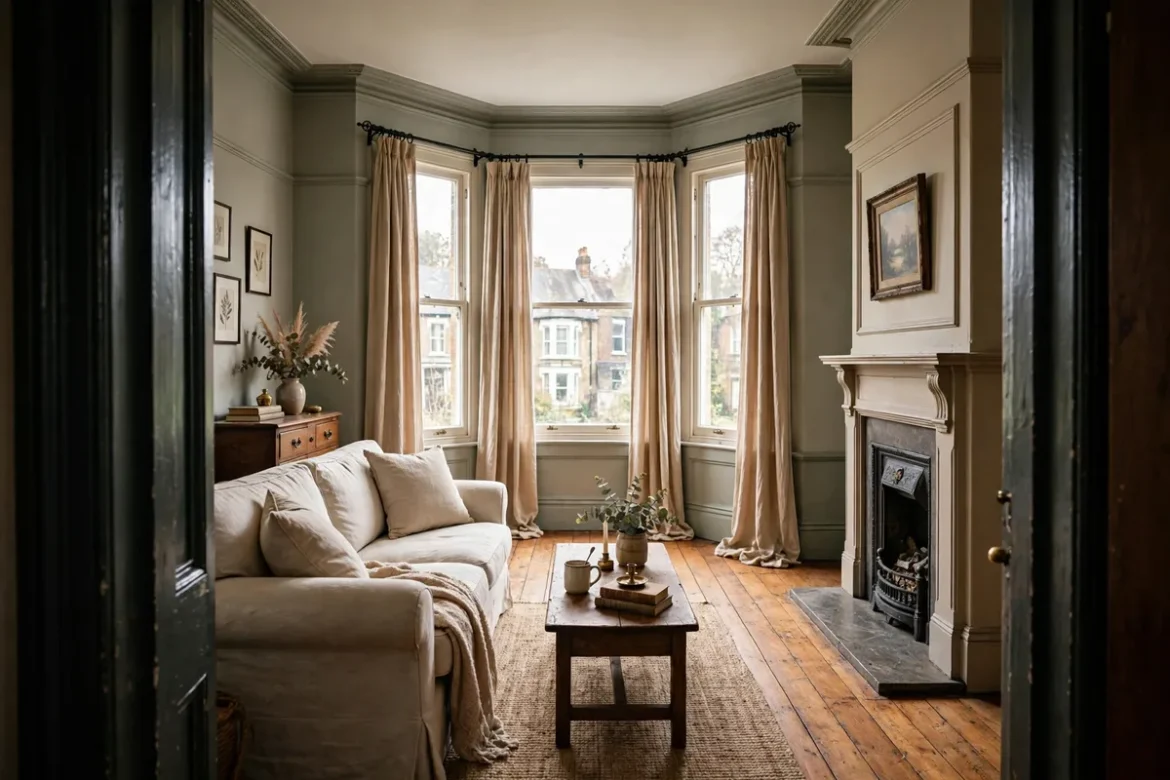
Float is the crispest finish. The hem sits 0.5 to 2.5 cm above the floor, with a visible gap that is small enough to look deliberate. It is the easiest finish to live with, because the curtain never touches the floor, so it never drags, never collects dust from the floor, and never gets caught under a foot. It is the best choice for a home with pets or small children, for a high traffic room, and for a floor that is not quite level, because a small gap hides unevenness better than a hem that is meant to touch everywhere. The float is the safest default for most UK living rooms.
Kiss, sometimes called graze, is the designer favourite. The hem just touches the floor, with no gap and no extra fabric, so the curtain meets the floor in a clean line. It is the best finish for blocking light and draughts, because there is no gap at the bottom for light to leak through, and it looks the most tailored of the four. It is also the hardest to get right, because the floor must be level and the measurement exact. In an older UK home, where floors are rarely level, a kiss finish can end up floating on one side and puddling on the other, which is why the guides checked recommend measuring in at least three places, as the measuring section below explains.
Break is a slight excess, 2.5 to 5 cm longer than the exact floor measurement, so the hem bends gently where it meets the floor, like the break in a trouser leg. It suits heavier fabrics, such as lined cotton or velvet, which hold the bend well, and it suits rooms where the floor is uneven, because the extra fabric absorbs the variation. It reads as relaxed rather than crisp, and it is a good middle choice between a kiss and a puddle.
Puddle is the most dramatic finish, with 15 cm or more of extra fabric pooling on the floor. Some guides give 5 to 15 cm for a light puddle and 15 to 30 cm for a full one. It suits formal rooms, tall windows, and heavy fabrics that hold a fold. It is the most upkeep, because the fabric on the floor needs regular vacuuming and will mark, and it is a poor choice for a room with pets, children, or a lot of foot traffic past the window. Choose a puddle because the room is formal and you want the drama, not because the curtains arrived too long.
The One Mistake: The Hover
Every guide checked names the same mistake, and it is worth naming it plainly, because it is the mistake most people make without realising it. A hem that hovers 5 to 10 cm above the floor, too long to be a sill length and too short to be a floor length, reads as curtains ordered too short. It is not a style choice. It does not look deliberate. It looks like a measurement error, and it draws the eye to the gap every time you look at the window.
If your curtains hover in that band, the fix is to lengthen them to a float, which is only a centimetre or two of difference, or to shorten them deliberately to a sill or apron length, if something below the window justifies it. What does not work is leaving them in between. The same rule applies when buying ready made curtains. Standard ready made lengths in the UK are usually 213 cm, 244 cm and 274 cm, which are 84, 96 and 108 inches, and they rarely land exactly on a float or a kiss in a real room. Measure first, as the section below explains, and buy by the measurement, not by the label. A pair of ready made curtains that lands in the hover band is a pair that needs altering, not a pair to live with.
Rod Position: How High and How Wide
The length of a curtain is measured from the rod, not from the window, so the rod position decides the length. Getting the rod right is the first step, and it is also the step that makes a window look taller than it is.
Hang the rod 10 to 15 cm above the window frame, or closer to the ceiling if you want a taller look. In a typical UK room with a ceiling height of about 2.4 metres, that usually means the rod sits well above the frame, with a band of wall showing between the top of the frame and the rod. That band is deliberate. It makes the window read as taller, and it gives the curtain a proper drop. Hanging the rod right on top of the frame, or only a couple of centimetres above it, wastes the height and makes the window look squat.
Extend the rod 20 to 30 cm past the frame on each side. One source gives 10 to 25 cm, but the consensus is 20 to 30 cm, and the reason is practical. When the curtains are open, the panels need somewhere to stack that is not over the glass, so the window is fully clear and the light comes in. A rod that ends at the frame forces the panels to cover part of the window even when they are open, which loses light and makes the window look smaller. The extra width also means the curtain, when closed, covers the frame and a little of the wall on each side, which blocks light at the edges and looks properly finished.
For a bay window, which is common in Victorian terraces, the same principle applies on a bay pole or a bay track, which follows the shape of the bay. Our guide to furniture layout mistakes in long narrow living rooms explains how a bay shapes the seating at the front of a through lounge, and the curtain rule follows the same logic. The rod or track must follow the bay so the panels can stack clear of the glass at the sides, and the length must be measured at each section of the bay, because the floor is rarely level across the full width of a bay.
Fullness: How Wide the Curtains Should Be
A curtain that is the same width as the window will hang flat, like a sheet, and it will look thin and mean. The rule the guides checked agree on is that the combined width of the two panels, laid flat, should total two to two and a half times the width of the rod. That is the fullness ratio, and it is what gives a curtain its folds when it is closed.
For a rod 200 cm wide, that means 400 to 500 cm of curtain fabric in total, or 200 to 250 cm per panel. For a narrower window, the same ratio applies, so a 120 cm rod needs 240 to 300 cm of fabric. The exact ratio depends on the fabric. A heavy fabric, such as velvet or lined cotton, holds its folds well and can sit at the lower end of the range. A light fabric, such as linen or a sheer, needs more fullness to look generous, so aim for the higher end. A curtain sold as a pair is usually sold by the width of one panel, so check whether the width on the label is per panel or for the pair before you buy.
Fullness also affects the length. A curtain with generous fullness hangs with deeper folds, and those folds take up a little of the length, so a curtain measured flat may sit a centimetre or two shorter when it is hung and gathered. That is one more reason to measure from the rod, in the position the curtain will actually hang, rather than measuring the fabric on a table.
How to Measure: From the Rod, in Three Places
Measuring is the part people rush, and it is the part that decides whether the hem lands on a float, a kiss or a hover. The method below is the consensus of the guides checked, and it takes ten minutes.
First, fit the rod or track in its final position, at the height and width described above, with the rings or gliders in place. Do not measure from the window frame. Measure from the bottom of the rod, or from the bottom of the ring or clip if the curtain hangs from rings, because that is where the fabric actually starts.
Second, measure in at least three places: left, centre and right. Floors in UK homes are rarely level, especially in period houses, and the drop can vary by a centimetre or more across the width of a window. If the three measurements differ, use the shortest one for a float or a kiss, so the hem never puddles on the high side, or plan a break, which absorbs the variation.
Third, adjust the measurement for the finish you have chosen. For a float, subtract 0.5 to 1 cm from the exact floor measurement. For a kiss, use the exact measurement, with no addition and no subtraction. For a break, add 2.5 to 5 cm. For a puddle, add 15 cm or more. Write the finished length down, in centimetres, before you order, and check it against the ready made lengths available. If no ready made length matches, have the curtains altered, or buy made to measure, rather than accepting a length that lands in the hover band.
Fourth, measure the width. Measure the rod from end to end, including the return to the wall, and multiply by two to two and a half for the fullness ratio. Then check the width of the panels you are buying, per panel, and make sure the total is in range.
Finally, check the window itself. Measure the frame, note where the radiator sits, if there is one below the window, and note the floor: hard floor, carpet, or a rug. Our guide to rug size guide for UK living rooms explains the border of bare floor a rug needs around it, and the same logic applies at a window. A curtain that puddles onto a rug will mark the rug, and a curtain that floats above a rug leaves a gap that shows the rug edge. Decide the finish with the floor in mind, not in isolation.
When Curtains Should Stop Short: The Exceptions
The exceptions are as important as the rule, because a floor length curtain in the wrong place is a practical problem, not just a style mistake.
Kitchens and bathrooms come first. In a kitchen, a long curtain will get splashed, stained and caught on worktops, and in a bathroom it will get damp. Stop at the sill or the apron in both rooms, 1 cm above the sill or 10 to 15 cm below it, and choose a fabric that tolerates moisture and can be washed. The same applies to a utility room or a cloakroom with a window above a sink or a worktop.
Windows above a radiator are the second exception. A long curtain hanging over a radiator traps heat behind the fabric, which wastes energy and, with older radiators, can be a fire risk. Keep the hem 2.5 to 5 cm above the top of the radiator, so the heat can circulate into the room. If the radiator sits below a long window and you want the floor length look, consider a sill or apron length instead, or move the curtain to a track that sits clear of the radiator. Never let a curtain rest on a hot radiator.
Pets and small children are the third exception. A dog that sleeps against the window, a cat that climbs the curtain, or a toddler who pulls at the hem will all make a puddle finish unworkable, and a kiss finish will be dragged and dirtied within a week. In those rooms, choose a float, with the hem 0.5 to 2.5 cm above the floor, so there is nothing to catch, pull or lie on. The same applies to a high traffic route past a window, such as a patio door or a French window that is used every day. A float is the practical finish, and it still looks deliberate.
A desk, a sideboard or a chest of drawers below a window is the fourth exception. If furniture sits hard against the wall under the window, a floor length curtain will bunch behind it or hang in front of it, and neither looks right. Stop at the sill or the apron, so the curtain clears the furniture, and let the furniture, not the curtain, dress the wall below the window.
Curtains and the Rest of the Room
Curtains do not exist on their own. They sit in a room with a wall colour, a rug, a sofa and lamps, and the length decision should be made with those in mind.
The wall colour matters, because a curtain in a colour close to the wall will blend in and make the window look larger, while a curtain in a strong contrasting colour will frame the window and make it a feature. Our guide to paint colours that make a small room look bigger explains how pale colours reflect light and dark colours absorb it, and the same rule applies to curtains. A pale curtain in a small room will keep the room bright. A dark, heavy curtain in a small room will close it in, unless the room has good light and the curtain is drawn back for most of the day.
The rug matters too, because the rug and the curtain together mark the floor area of a room. A rug that is the right size for the sofa, with the front legs on it and a border of bare floor around it, gives the room its proportions, and a curtain that meets the floor cleanly continues that line. A curtain that puddles onto a rug, or a curtain that hovers above a rug edge, breaks the line and draws the eye to the mismatch. Settle the rug size first, then the curtain length, so the two agree.
The light matters most of all. A curtain that blocks light when it is closed is doing its job, and a curtain that stacks clear of the glass when it is open is doing its job too. Our guide to layered lighting design for a living room explains the three layers, ambient, task and accent, and the same principle applies in daylight. The curtain is part of the light plan, not separate from it. A window dressed with a floor length curtain on a wide rod, stacked clear of the glass, gives the room more daylight than the same window with a short curtain on a narrow rod, because the glass is fully exposed when the curtains are open.
A Worked Example: A 3.5m by 7m Through Lounge
Take a typical Victorian through lounge, 3.5 metres wide and 7 metres long, with a bay window at the front, a chimney breast in the middle of one long wall, and a three seater sofa facing the fireplace wall. The bay is the main window, and it is where the curtain decision matters most.
Fit a bay track that follows the shape of the bay, 10 to 15 cm above the window frames, extending 20 to 30 cm past the frame on each side where the bay allows it. Measure from the bottom of the track in three places across the bay, left, centre and right, and take the shortest measurement. Suppose the shortest drop is 248 cm. For a float, order 247 cm. For a kiss, order 248 cm. For a break, order 250 to 253 cm. For a puddle, order 263 cm or more.
For the width, suppose the bay track measures 300 cm from end to end. At a fullness ratio of two to two and a half, the panels need 600 to 750 cm of fabric in total, or 300 to 375 cm per panel. That is a lot of fabric, and it is why bay windows need generous curtains. A pair of panels that totals only 400 cm will hang flat across a 300 cm bay and look thin, however good the fabric is.
Choose a float for this room, because the bay is the main light source and the curtains will be opened and closed every day, and a float is the easiest finish to live with. Choose a fabric in a colour close to the wall, so the bay reads as larger, and hang the curtains so they stack clear of the glass at the sides of the bay, so the light comes in fully during the day. At night, the same curtains close across the full bay and block the light, because the track extends past the frames and the panels overlap in the middle.
Rented Homes: What You Can and Cannot Change
In a rented home, the curtain length rules still apply, but the rod is often the constraint. Many rented homes come with a curtain track or a rod already fitted, and the tenancy agreement may not allow you to move it or drill new holes. If the rod is fixed in a poor position, close to the frame or too narrow, the length you can achieve is limited by it, and the best you can do is to measure from the rod that is there, choose the best finish available, and use the width you have.
If the rod is too narrow for the panels to stack clear of the glass, choose a lighter fabric that stacks more compactly, or accept that the curtains will cover a little of the glass when open, and compensate with a paler colour that lets more light through. If the rod is too low, a float finish is still achievable, because the float is measured from the rod, not from the ceiling, and a low rod with a float hem still looks deliberate, even if the window does not read as tall as it could. Do not drill new holes or fit a new rod without the landlord’s written permission, and do not assume that a curtain pole fitted by a previous tenant is safe to load with heavy curtains. Check the fixings first.
Mistakes to Avoid
The most common mistake is the hover, a hem 5 to 10 cm above the floor, which reads as curtains ordered too short. It is the mistake this guide returns to, because it is the one most people make, and the fix is a centimetre or two in either direction.
The second mistake is measuring from the window frame instead of the rod, which gives a length that is too short by the distance between the frame and the rod, usually 10 to 15 cm. That is exactly the hover band, and it is how most hover mistakes happen. Measure from the rod, or from the bottom of the ring, every time.
The third mistake is measuring in one place only, in a room where the floor is not level. A curtain that kisses the floor on the left and floats on the right is a curtain measured once. Measure in three places, and use the shortest measurement for a float or a kiss.
The fourth mistake is buying by the label instead of by the measurement. Ready made lengths of 213, 244 and 274 cm are standard sizes, not your window size, and they rarely land on a float or a kiss. If the label length lands in the hover band, have the curtains altered, or buy a different length, rather than hanging them as they are.
The fifth mistake is skimping on fullness. A curtain with a fullness ratio below two will hang flat and look thin, whatever the length. Buy the width first, then the length, and check the width on the label is per panel, not for the pair.
The sixth mistake is a puddle in the wrong room. A puddle finish in a kitchen, a bathroom, a child’s bedroom or a home with a dog is a curtain that will be dirty, pulled and trodden on within a week. Choose the finish for the room you have, not for the photograph you saw.
The seventh mistake is hanging the rod too low and too narrow. A rod fitted right above the frame, ending at the frame, makes the window look small and forces the curtains to cover the glass when open. Fit the rod 10 to 15 cm above the frame and 20 to 30 cm wider on each side, and the same curtains will look taller and give the room more light.
Frequently Asked Questions
Should curtains touch the floor?
Yes, in most living rooms and bedrooms. The hem should touch the floor, in a kiss finish, or float 0.5 to 2.5 cm above it, in a float finish. Both read as deliberate and finished. The exceptions are kitchens and bathrooms, windows above a radiator, rooms with pets or small children, and windows with furniture hard against the wall below them, where a sill or apron length, or a float, is the right choice instead.
How long should curtains be for a standard window?
Measure from the bottom of the rod to the floor, in three places, and use the shortest measurement. For a float, subtract 0.5 to 1 cm. For a kiss, use the exact measurement. For a break, add 2.5 to 5 cm. For a puddle, add 15 cm or more. Standard ready made lengths are 213, 244 and 274 cm, but they rarely match a real window exactly, so measure first and alter if needed.
What is the best curtain length for a living room?
Floor length, in a float or a kiss finish, is the best choice for most living rooms. A float is the easiest to live with and the most forgiving of uneven floors. A kiss is the most tailored and the best for blocking light and draughts, but it needs a level floor and an exact measurement. A puddle suits a formal living room where the curtains are a feature. Avoid a hem hovering 5 to 10 cm above the floor, which reads as curtains ordered too short.
How high should a curtain rod be above the window?
Hang the rod 10 to 15 cm above the window frame, or closer to the ceiling for a taller look. Extend it 20 to 30 cm past the frame on each side, so the panels stack clear of the glass when they are open. Measuring the curtain length from the rod, not from the frame, is what makes the hem land where you intend it to.
How wide should curtains be?
The combined width of the two panels, laid flat, should total two to two and a half times the width of the rod. For a 200 cm rod, that is 400 to 500 cm of fabric in total. Heavy fabrics can sit at the lower end of the range, and light fabrics need the higher end. Check whether the width on the label is per panel or for the pair before you buy.
Should curtains touch the floor in a bedroom?
Yes, the same rule applies. A float or a kiss finish suits a bedroom, because it blocks light at the bottom of the window and makes the room look finished. A puddle suits a formal bedroom, but it collects dust and is a poor choice if there are pets or small children in the room. If the bedroom window sits above a radiator, stop the hem 2.5 to 5 cm above the radiator instead.