Bedroom Colour Schemes for Small Bedrooms: Palettes That Make a Box Room Feel Bigger
A small bedroom is unforgiving. In a box room, a spare room or a second bedroom in a terrace, the bed takes up most of the floor, the wardrobe takes up most of one wall, and there is nowhere for a wrong colour to hide. A shade that looks calm on a sample card can close the room in once it covers all four walls, and a feature wall that looks striking in a showroom can make the bed feel as if it is pushed into a corner.
Colour will not make a small bedroom physically larger, and any guide that promises that is overselling paint. What colour can do is stop a small bedroom feeling cramped, dark or busy, and that is usually enough. The right scheme keeps the walls receding, the ceiling feeling high, the bed looking intentional rather than oversized, and the eye moving around the room instead of stopping at a clash of colours. This guide starts with light, because light decides which colours work, then gives schemes by the direction the room faces, the rules for ceilings, feature walls, bedding and furniture, and a worked box-room example.
It is a companion to our guides to north-facing living room colours and south-facing room colours. The undertone rules in those guides apply in a bedroom too, because the light is the same light, only the room is smaller and you spend more time in it in the dark.
Start With Light, Not With a Favourite Colour
Before you choose a colour, work out what light the bedroom actually gets. Stand in the room in the morning, at midday and in the evening, and note where the light falls and where it never reaches. A bedroom with one small window, a bedroom under a sloping ceiling, and a bedroom whose window faces a neighbouring wall all behave differently, even if they are the same size on paper.
Use a phone compass at the window to check the direction the window faces, not the direction you walk into the room from. Watch the light through the day as well. A room that gets a clear burst of morning sun faces east. A room that warms up late in the afternoon faces west. A room that stays steady, with no strong patch of sun moving across the floor, is probably north-facing. A room that is bright for most of the day, sometimes too bright, is probably south-facing. In a room with two windows on different walls, test each end separately, because the end by the bed and the end by the wardrobe can need slightly different handling.
Light also comes from the room itself. A bedroom painted in a dark colour with heavy curtains and a dark wardrobe will feel darker than the same room painted pale with sheer curtains and a light wardrobe, even with the same window. Colour, curtains, flooring and furniture all change how much of the available light is reflected back to you. In a small room, that reflection matters more than in a large room, because there is less wall to bounce light around in the first place.
Test every shortlisted colour in the bedroom itself, on the wall behind the bed and on the darkest wall, not in the shop and not in the living room. Paint a swatch at least the size of a sheet of paper, and look at it in daylight, in the evening with the bedside lamps on, and with the curtains open and closed. A colour that only works when the curtains are open will disappoint for most of the year, when you are in the bedroom mainly in the morning and evening. If the swatch turns grey in the morning or yellow under lamplight, the undertone is wrong for the light you actually have, however good it looked on the card.
The Rules That Keep a Small Bedroom Calm
Most small-bedroom colour mistakes come from breaking a few simple rules, not from choosing an unfashionable shade. Keep these in mind before you look at palettes.
First, keep the main surfaces light and consistent. In a small bedroom, the walls, the ceiling and the largest pieces of furniture should sit in the same light family, so the room reads as one calm space rather than a collection of competing blocks. That does not mean everything must be white. A pale warm white, a pale greige, a pale sage or a pale blue-grey can all be the main colour, provided the bedding, the wardrobe and the curtains stay close to it in tone.
Second, use one stronger colour, not three. A small room has no room for a strong wall colour, a strong bedspread, a strong rug and strong curtains all fighting for attention. Choose one place for the stronger colour, usually the wall behind the bed, or the bedding, or a single piece of furniture, and keep everything else quiet. This is the 60-30-10 idea in practice: about 60 percent of the room in the main pale colour, about 30 percent in a supporting mid-tone, and about 10 percent in an accent colour. In a small bedroom, it helps to keep the accent at the low end, because an accent that is too large stops being an accent and becomes a second main colour.
Third, keep contrast soft. Sharp contrast, such as a very dark wall next to a very white ceiling, or black furniture against pale walls, chops a small room into pieces and makes each piece feel smaller. Soft contrast, such as pale walls with slightly deeper bedding, light wood with warm white woodwork, and a mid-tone rug on a pale floor, lets the eye travel smoothly around the room. If you love a dark colour, use it in a soft way: on one wall only, in bedding and cushions rather than on all four walls, or in a deep-toned headboard against pale walls.
Fourth, match the undertone across the room. A warm white wall with a cool grey wardrobe and a cool blue duvet cover will feel unsettled, even if each item looks fine on its own. Pick a warm or a cool direction for the room, and keep the walls, bedding, curtains and rug in that direction. Warm rooms suit warm whites, greige, sage with a warm base, dusky pink and ochre accents. Cool rooms suit cool whites, pale blue-grey, soft green-grey and silver accents. Mixing warm and cool undertones is the most common reason a small bedroom feels wrong without an obvious cause.
Schemes by Light Direction
The same pale colour behaves differently in north light and in south light, so the scheme should follow the direction the bedroom faces.
North-facing small bedrooms: add warmth
A north-facing bedroom gets indirect light for most of the day, with a cool, blue-grey cast. Colours in that light shift cooler too, so the job of the palette is to add back the warmth the light takes away. This is the same problem as a north-facing living room, and the same warm undertone rule applies.
Start with a warm white on most walls, with a soft yellow, pink or beige undertone, not a brilliant or pure white, which can turn grey-blue in north light. Add warmth with a feature wall or bedding in warm greige, dusky pink, warm sage or warm taupe. Use ochre, rust or terracotta in cushions, a throw and artwork, because those accents inject the golden warmth the room never gets from the sun. Keep the ceiling plain white, keep woodwork in a warm white, and choose warm white bulbs for bedside lamps, so the evening light supports the palette rather than fighting it.
Avoid icy blues, blue-greys, cool lilacs and mint greens on large areas in a north-facing bedroom. They match the cool light instead of balancing it, and the room can feel colder and more washed out. A deep warm navy or deep warm green can work on one wall in a larger small bedroom, meaning a room that is small but not a true box room, provided the other walls stay warm and light and the lamps are warm. In a true box room, keep dark colours to bedding and furniture, not to the walls.
South-facing small bedrooms: keep cool and calm
A south-facing bedroom gets strong light for much of the day, and in summer it can feel too bright and too warm. Here the job is the opposite: to keep the room feeling cool and calm without making it look cold in winter, when the light is lower. Our guide to south-facing room colours explains the cooling palette in detail, and the bedroom version follows the same logic.
Start with a cool pale neutral: a pale blue-grey, a soft green-grey, or a cool white that does not turn yellow in strong afternoon light. Pair it with white or very pale bedding, light curtains that filter rather than block the light, and pale flooring or a pale rug. Use deeper cool colours sparingly, in cushions or a throw, so the room still has depth without absorbing too much light. Avoid warm creams and strong warm yellows on large areas in a south-facing bedroom, because strong sun will push them further towards yellow and the room can feel hot rather than calm.
Watch fading in a south-facing bedroom. Strong sun fades bedding, curtains and artwork faster than in any other room, so choose washable bedding in colours that fade gracefully, keep valuable artwork out of direct sun, and use sheer curtains or a blind that can be drawn during the brightest part of the day. A colour scheme that looks perfect in June but faded by September is not a good scheme for a south-facing room.
East-facing small bedrooms: soft morning light
An east-facing bedroom gets clear morning light and softer light later in the day. This suits a bedroom well, because the morning light is useful when you wake up, and the room does not overheat in the afternoon. Pale warm neutrals work well here: warm white, pale greige and soft sage all look fresh in morning light and stay calm in the evening. Avoid very cool whites, which can look flat once the morning sun has moved on. A soft warm accent in bedding, such as a muted ochre or a dusty pink cushion, will still read warm in the evening under lamplight.
West-facing small bedrooms: warm evening light
A west-facing bedroom gets softer light in the morning and warm light late in the afternoon and evening. This is the room most likely to look golden at the time you use it most. Pale cool neutrals can balance that warmth: a pale blue-grey or a soft green-grey will stop the evening light turning the room too yellow, while still feeling calm in the morning. If you prefer a warm scheme in a west-facing bedroom, keep the walls pale and let the evening light do the warming, rather than adding more warmth with a strong warm wall colour. Test swatches in the late afternoon, not just in the morning, because that is when a west-facing bedroom shows its true colour.
Windowless or very dark box rooms
Some small bedrooms have a tiny window, a window facing a lightwell, or a window blocked by a neighbouring building. In those rooms, treat the light as north-facing even if the compass says otherwise, because the light that actually arrives is indirect and weak. Keep all walls pale and warm, keep the ceiling white, use mirrors to bounce what light there is, and rely on layered bedside and wall lighting in the evening. A dark feature wall in a windowless box room will almost always make the room feel smaller, however good it looks in a photograph of a larger room.
Ceilings, Woodwork and the Fifth Wall
In a small bedroom, the ceiling is not a detail. It is the largest uninterrupted surface in the room, and it decides whether the room feels tall or squat. In almost every small bedroom, keep the ceiling plain white. White reflects light back down into the room and makes the junction between wall and ceiling feel higher. Painting the ceiling the wall colour can work in a room with high ceilings, where it softens the junction and makes the room feel more enclosed and cosy, but in a typical box room with a standard ceiling height it will make the ceiling feel lower.
Keep woodwork, doors, skirting and window frames in a clean white that is one step lighter or cleaner than the walls. That gives the room crisp edges and stops doors and skirting blending into a muddy whole. If the walls are warm white, use a slightly cleaner white for woodwork. If the walls are a pale colour, use white woodwork to frame the colour rather than matching it exactly. Paint the inside of the wardrobe doors the same white as the woodwork where possible, so an open wardrobe does not introduce a dark block into a pale room.
If the bedroom has a sloping ceiling, as in a loft room, keep the slope the same pale colour as the walls, or white, and avoid a dark colour on the slope. A dark slope presses down visually, and in a room where you already have to duck in places, that is the last effect you want. Use the lowest part of the slope for low storage, such as drawers or a low chest, and keep the higher part of the room for the bed and for standing space.
Feature Wall or All Four Walls?
A feature wall is the most debated choice in a small bedroom, and the answer depends on the size of the room and the strength of the colour.
In a box room, the safest feature wall is the wall behind the bed, in a muted mid-tone rather than a dark colour: warm greige, muted sage, dusty blue, dusky pink or warm taupe. That wall gives the bed a backdrop and the room a focal point, without closing in the other three walls. Keep the other walls pale, keep the ceiling white, and repeat the feature colour in bedding or cushions, so the feature wall looks connected to the rest of the room rather than pasted on.
Painting all four walls in a mid-tone can work in a small bedroom, but only when the colour is pale enough and the light is good enough. A pale sage, a pale greige or a pale blue-grey on all four walls, with white bedding, light curtains and a light floor, can make a small bedroom feel calm and cocooning rather than cramped, because there are no sharp changes of colour to chop the room up. A mid-tone or dark colour on all four walls, by contrast, will make most box rooms feel smaller, especially in north light or with a small window.
If you are unsure, start with one wall. It is far easier to paint the other three walls later than to repaint a dark room back to pale. Live with the feature wall for a few weeks, with bedding and lamps in place, before deciding whether the room needs more colour or whether the single wall is doing enough work on its own.
Bedding, Furniture and Flooring: The Colours You Live With
Wall colour is only part of a bedroom scheme. Bedding covers the largest piece of furniture in the room, so it is effectively a second wall colour. In a small bedroom, keep the main bedding pale: white, warm white, pale grey or pale sage, with colour in cushions, a throw and a bedspread folded at the foot of the bed rather than in the whole duvet cover. That way you can change the accent colour with the seasons without repainting, and the bed does not dominate the room in a strong colour all year.
Furniture colour should follow the same logic. Light wood, white or pale painted furniture keeps a small bedroom feeling open, because it does not create dark blocks against pale walls. Dark wood furniture can work, but it needs pale walls, pale bedding and good lighting to balance it, and it works better as one piece, such as a headboard or a chest of drawers, than as a full matching dark suite. If you already have dark furniture, do not repaint the walls dark to match it. Keep the walls pale, keep the bedding pale, and let the dark furniture be the contrast in the room.
Flooring should be pale or mid-tone and consistent. A pale wooden floor, a light carpet or a pale rug over a darker floor all help a small bedroom feel larger, because the floor reads as one continuous surface. A dark rug that covers most of the floor will chop the room in half, just as a dark wall does. If you use a rug, choose one large enough for the bed to sit on, or for the front feet of the bed to sit on, so the sleeping area reads as one zone, and keep the rug in the same colour family as the bedding.
Curtains should be light enough to let in daylight during the day, and long enough to frame the window without blocking it. In a small bedroom, curtains in a pale linen or a soft voile, hung from a pole or track close to the ceiling and extending slightly beyond the window on each side, make the window look larger and let in more light. Heavy dark curtains, hung inside the window recess, make the window look smaller and the room darker, even when they are open.
Storage, Mirrors and Light: The Partners of Colour
Colour works best when storage, mirrors and lighting support it. A small bedroom with clothes on chairs, boxes on the floor and a wardrobe door that will not close will feel cramped whatever colour the walls are. Our guide to small bedroom storage ideas covers under-bed drawers, wall-mounted shelves, over-door organisers and mirrored wardrobes, all of which keep the floor clear and therefore make the colour scheme visible. In colour terms, the key point is simple: closed, pale storage helps a small bedroom look bigger, while open, dark, overflowing storage fights the palette.
Mirrors help a small bedroom in the same way they help a narrow hallway: they bounce light and a pleasant view back into the room, provided they reflect something worth reflecting. A large mirror on the wall opposite the window, or a mirrored wardrobe door, will double the light and make the room feel wider. A mirror opposite clutter, or opposite a dark wardrobe, will double the clutter. Place mirrors at a height where they reflect the window or a light wall, not the ceiling or the floor, and keep the frame slim and pale so the mirror itself does not become a dark block.
Lighting in a bedroom needs layers, just as in a living room. A ceiling light alone creates glare at the top and shadows at the bottom, and it makes wall colours look harsh. Add bedside lamps with warm white bulbs, at a height where the light falls on the bedding and the wall behind the bed rather than directly into your eyes. If the room has a dark corner, a small wall light or a lamp in that corner will stop the corner disappearing into shadow, which is where small bedrooms lose their sense of size. Keep bulb colours consistent from lamp to lamp, so the wall colour looks the same on both sides of the bed.
A Worked Example: The Box Room
Take a typical box room: about 2.4 metres by 2.7 metres, one window facing north, a single bed or a small double bed against one wall, a wardrobe on the opposite wall, and a standard ceiling height. This is the hardest small bedroom to decorate, and it is also the most common second bedroom in a UK terrace or flat.
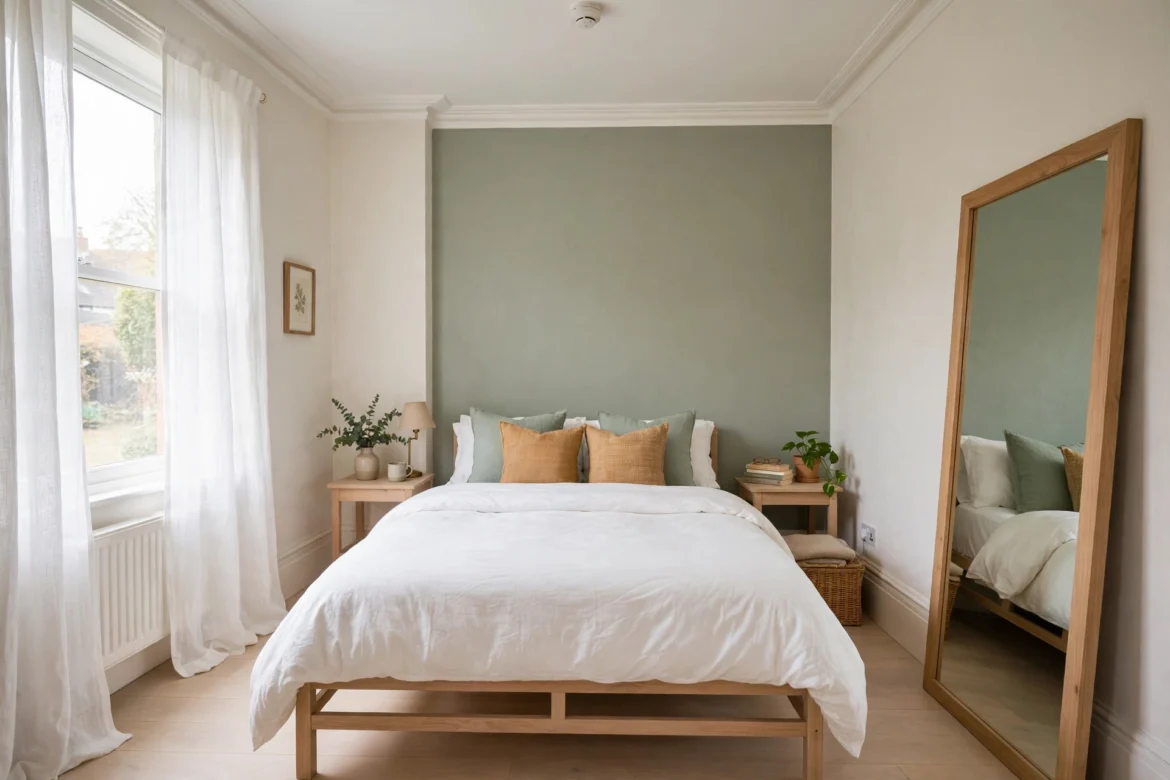
Start with the light: north-facing, indirect and cool. Choose warm white for three walls and the ceiling in plain white. Choose one feature wall, the wall behind the bed, in warm greige or muted sage. Keep woodwork in warm white, keep the wardrobe pale or white, and choose light wooden bedside tables rather than dark ones.
For bedding, choose white or warm white as the main colour, with sage cushions to repeat the feature wall and one ochre cushion as the accent. Add a light rug beside the bed, in a warm neutral, large enough to step onto in the morning. Hang pale linen curtains from close to the ceiling, extending slightly beyond the window, so the window looks larger than it is. Add a large mirror on the wall opposite the window, or a mirrored wardrobe door if the wardrobe is on that wall, to bounce light across the room.
For lighting, use a dimmable ceiling light in warm white, plus two bedside lamps with warm white bulbs. In the evening, the lamps will warm the greige or sage feature wall and make the room feel cosy rather than cold, which is exactly what north light fails to do on its own. In the morning, the pale walls and the mirror will make the most of the indirect daylight.
The result is not a room that looks larger in a photograph. It is a room that feels calm when you walk into it, that does not fight its own light, and that leaves room for one strong accent without becoming busy. That is the realistic goal for a box room, and it is achievable with paint, bedding and lamps, without knocking down walls or buying new furniture.
Schemes by Property Type
A small bedroom is not one problem, and the best scheme depends on the house as well as the light.
Terrace box room. Often north-facing or facing a neighbouring wall, with a small window and a low ceiling. Keep all walls pale and warm, use one muted feature wall behind the bed, and rely on mirrors and bedside lamps. Avoid dark walls and heavy curtains, which will make an already small room feel enclosed.
New-build flat second bedroom. Often square, with a larger window but less character, and pale walls already in place. Here the risk is blandness rather than darkness. Add character with a muted feature wall, textured bedding in sage or dusky pink, and warm wood accents, rather than with a strong colour on all four walls, which can make a new-build room feel smaller than its measurements suggest.
Loft bedroom. Sloping ceilings, dormer windows and awkward corners. Keep slopes pale or white, use the same pale colour on walls and slopes so the room reads as one shape, and put the bed under the highest part of the ceiling where possible. Use low, pale storage under the slope, and avoid dark colours on the slope itself.
Cottage bedroom. Low ceilings, small windows, uneven walls and beams. Keep colours warm and pale, use warm white and warm greige rather than cool whites, and let beams and wooden furniture provide the depth. A muted sage or dusky pink feature wall behind the bed suits a cottage bedroom well, because it sits comfortably with warm wood and traditional features.
Rented small bedroom. You may not be able to paint at all, or only with permission. In that case, use the same scheme logic without paint: pale bedding, a light rug, pale curtains, a large mirror leaning against a wall, and cushions and throws in your chosen accent colour. Removable wall colour, such as a large framed fabric panel behind the bed, can give the effect of a feature wall without touching the paintwork.
Mistakes That Make a Small Bedroom Feel Smaller
A few common mistakes undo an otherwise good small-bedroom scheme. The first is a dark colour on all four walls in a room with little light. A dark colour can be cosy in a large bedroom with good lamps, but in a box room it will close the walls in, especially in north light.
The second is too many strong colours at once. A strong wall, a strong duvet cover, a strong rug and strong curtains in different colours make a small room feel busy and therefore smaller. Choose one strong colour, keep the rest pale, and repeat the strong colour in small amounts rather than introducing a new one in each item.
The third is mismatched undertones. Warm walls with cool bedding, or cool walls with warm wood, will feel unsettled even if each item looks fine alone. Pick a warm or cool direction and stay in it for walls, bedding, curtains and rug.
The fourth is a ceiling that is too dark or too busy. A coloured ceiling, a dark ceiling, or a ceiling covered in a strong pattern will make a small bedroom feel lower. Keep the ceiling white and plain, and let the walls and bedding carry the colour.
The fifth is forgetting evening light. A bedroom scheme chosen only in bright daylight will disappoint in the evening, when you actually use the bedroom most. Check swatches and bedding under bedside lamps, with curtains closed, before you commit. If a colour only works in daylight, it is not the right colour for a bedroom.
The sixth is letting storage and clutter fight the colour. A pale, calm scheme with clothes on every chair and boxes on the floor will still feel cramped. Sort storage first, or at the same time as colour, so the palette has a clear room to work in.
Frequently Asked Questions
What colour makes a small bedroom look bigger?
No colour makes a room physically bigger, but pale, consistent colours with soft contrast make a small bedroom feel larger. Warm white, pale greige, pale sage and pale blue-grey, used on most walls with a white ceiling and pale bedding, reflect light and let the eye travel around the room without stopping at sharp changes of colour.
Should I paint all four walls the same colour in a small bedroom?
You can, provided the colour is pale enough and the light is good enough. A pale colour on all four walls can feel calm and cocooning. A mid-tone or dark colour on all four walls will make most box rooms feel smaller. If you are unsure, paint one feature wall behind the bed in a muted mid-tone and keep the other walls pale.
What is the best feature wall colour for a small bedroom?
A muted mid-tone that suits the light: warm greige, muted sage, dusty blue or dusky pink. Choose a warm undertone for a north-facing room and a cooler undertone for a south-facing room. Repeat the feature colour in cushions or a throw, so the wall looks connected to the rest of the room.
Should the ceiling be white in a small bedroom?
Yes, in almost every small bedroom. A plain white ceiling reflects light and makes the room feel taller. Painting the ceiling the wall colour only works well in a room with high ceilings. In a standard box room, a coloured ceiling will make the ceiling feel lower.
Can I use dark colours in a small bedroom at all?
Yes, in small amounts: in bedding, cushions, a headboard, or on one wall in a room that is small but not a true box room, with good lighting. Dark colours on all four walls, or dark furniture throughout a pale room, will make a small bedroom feel smaller and more enclosed.
What bedding colour suits a small bedroom?
Pale bedding as the main colour, white, warm white, pale grey or pale sage, with colour in cushions and a throw. That keeps the bed, the largest item in the room, from dominating in a strong colour, and it lets you change the accent colour without repainting.
How do I choose a colour for a north-facing small bedroom?
Choose warm undertones: warm white walls, warm greige or dusky pink or warm sage as the feature or accent, and warm white bulbs in bedside lamps. Avoid brilliant white, icy blues and cool greys on large areas, because north light will pull them cooler and the room can feel cold and grey.
How do I choose a colour for a south-facing small bedroom?
Choose cool pale neutrals, pale blue-grey or soft green-grey, with white bedding and light curtains that filter strong sun. Avoid warm creams and strong warm yellows on large areas, because strong sun will push them towards yellow, and watch for fading in bedding and curtains.