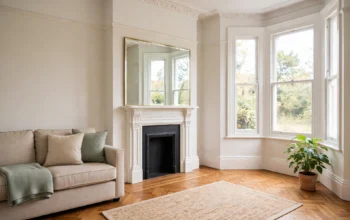
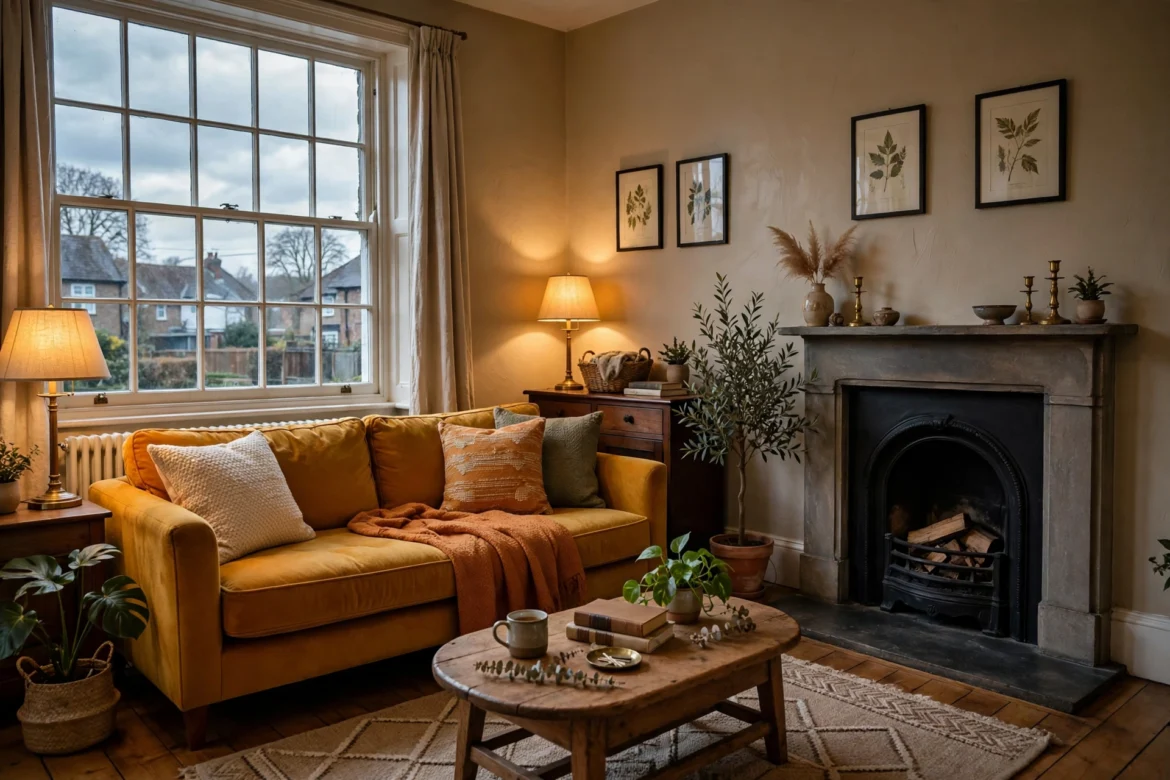
A north-facing living room can be the hardest room in a UK home to get right. The paint colour that looked perfect on the sample card can turn cold, grey or flat once it is on all four walls, and the room can feel gloomy even on a bright day. That is not a fault in your taste. It is the light. North-facing rooms receive indirect light for most of the day, and that light has a cool, blue-grey cast. Colours in that light shift cooler too, so the job of the palette is to add back the warmth the light takes away.
This guide explains how to work with that light rather than fight it: how to confirm your room really faces north, the undertone rule that decides most choices, the warm whites that stay warm, the colours that reliably work, the ones to avoid, and three ready-made palettes by property type.
Why North-Facing Rooms Look Cold
In the UK, a north-facing window rarely gets direct sun. The light that comes in is sky light, not sunlight, and it stays fairly even through the day. That evenness sounds helpful, but it means the room never gets the warm afternoon glow that flatters colour in a south-facing room. Shadows stay soft and cool, and pale colours can look washed out while mid-tone colours can look darker than expected.
Two things follow from this. First, you should judge paint in the room itself, in its own light, not in the shop or on a phone screen. Second, warm undertones matter more here than in any other room. A paint that is only slightly warm on the card can read as neutral in a north-facing room, while a paint that is only slightly cool can read as distinctly cold. If your living room always feels a little chilly even when the heating is on, the colour is often part of the reason, alongside curtains, flooring and lighting.
How to Check Which Way Your Living Room Faces
Before you buy paint, confirm the aspect. Guessing wrong leads to the wrong palette, especially in through-lounges where the front and back rooms face different ways.
- Use the compass on your phone and stand at the main window, facing out. Note the direction the window faces, not the direction you walk in from.
- Watch the light through the day. A north-facing room stays fairly steady, with no strong patch of sun moving across the floor. A room that gets a clear burst of morning sun faces east, and one that warms up late in the afternoon faces west.
- Check a map if the compass reading is unclear. Find your street, work out which side of the house the living room sits on, and read the direction from there.
- In a through-lounge, test each end separately. The front bay and the rear extension can need slightly different handling, even when they share one paint colour, because one end may borrow light from a side window or a glazed door.
If the room faces north-east or north-west rather than due north, the same warm palette still applies, with a little more flexibility. The closer the room is to due north, the more strictly you should follow the warm undertone rule below.
The Undertone Rule
Every paint colour has an undertone, the hint of another colour sitting underneath the main colour. A white can lean yellow, pink, grey or blue. A grey can lean warm towards beige or cool towards blue. In a north-facing room, the undertone decides how the colour actually looks on the wall, because the cool light pulls the undertone forward.
The rule is simple: choose warm undertones. Look for whites and neutrals described as warm, creamy or with a yellow, pink or beige base, and avoid those described as pure, brilliant, blue-based or icy. For greys, choose a greige, which is a grey mixed with beige, rather than a blue-grey. For greens, choose a sage with a warm, earthy base rather than a mint or a blue-green. For pinks, choose a dusky, muted pink rather than a bright or cool pink.
Test the rule before you commit. Paint a large swatch on the wall, at least the size of a sheet of paper, and look at it in the morning, at midday and in the evening with the lamps on. Small sample cards lie in north-facing light. A large swatch on the actual wall, next to your sofa and flooring, tells the truth. If the swatch turns grey or blue by midday, the undertone is too cool for the room, however warm it looked in the shop.
Warm Whites That Do Not Turn Yellow
Warm white is the safest starting point for a north-facing living room, but it needs care. The wrong warm white can turn yellow, especially under warm artificial light in the evening. The right one adds a gentle glow without looking cream or dated.
Look for a warm white with a soft yellow or beige undertone, not a strong cream. On the wall it should read as white in daylight, with just enough warmth to stop the cool light turning it grey. Avoid brilliant white and pure white in this room. They have no warmth to give, so the north light makes them look cold and slightly blue, and they can make the room feel stark rather than bright.
Pair the wall white with a slightly different white for woodwork, so doors and skirting do not disappear into the walls. A woodwork white one step warmer or one step cleaner than the wall colour gives a quiet contrast that reads as intentional. Keep the ceiling in a plain white rather than the wall colour, unless the ceiling is low and you want the room to feel taller, in which case carrying the wall colour up can soften the junction between wall and ceiling.
When you repaint, follow a careful method so the finish itself does not distract from the colour. Our guide to painting a room like a professional covers preparation, cutting in and the order of work.
Colours That Work
Once the warm white base is settled, these colour families work reliably in north-facing living rooms in UK homes:
Greige. A warm grey-beige is the workhorse of the north-facing palette. It is deep enough to give the walls presence, warm enough not to turn blue, and neutral enough to sit with most sofas and wooden floors. Use it on all four walls in a larger room, or on one or two walls with warm white elsewhere in a smaller room.
Dusky pink. A muted, earthy pink adds warmth without shouting. It suits Victorian terraces and period homes particularly well, because it sits comfortably with warm wood, brass and traditional fireplaces. Keep it muted rather than bright, and pair it with warm white woodwork so it reads as sophisticated rather than sweet.
Sage green. A warm sage brings a calm, natural feel and works well with wooden floors, plants and linen fabrics. Choose a sage with a yellow or earthy base. A sage that leans blue or mint will lose its warmth in north light and can look cold by afternoon.
Ochre and mustard accents. Ochre is best used as an accent rather than a wall colour in most north-facing rooms: cushions, a throw, a rug pattern, artwork or one armchair. It injects the golden warmth the room never gets from the sun, and it lifts greige, sage and warm white without overwhelming a small space.
Warm taupe and soft terracotta touches. A warm taupe works like greige but slightly deeper and browner, and suits rooms with dark wooden furniture. Terracotta, used sparingly in textiles and pottery, adds the same warmth as ochre with a more earthy feel. Both pair well with natural wood and cream, and both stop a north-facing room looking washed out.
The thread through all of these is warmth in the undertone, not brightness in the colour. A muted warm colour will look richer in north light than a bright cool colour, which will look thinner and colder.
Colours to Avoid and Why
Some colours that look excellent in a shop or in a south-facing room fail in a north-facing living room:
- Icy blues and blue-greys. They match the cool light instead of balancing it, so the room feels colder and the walls can look washed out or steely.
- Stark white and brilliant white. With no warm undertone, they turn grey-blue in north light and make the room feel clinical rather than bright.
- Cool lilacs and mint greens. Their cool base is pulled forward by the light, so they read as cold and sometimes slightly grey, even when they looked soft on the card.
- Very pale cool neutrals. A pale colour with a cool undertone can disappear in a north-facing room, leaving the walls looking unfinished rather than light.
This does not mean you can never use blue or green in a north-facing room. A deep, warm navy on one wall, or a deep warm green in a large room with good lamps, can work as a deliberate contrast. The risk is with pale and mid-tone cool colours spread across all four walls, where there is nothing warm to balance them.
Flooring, Fabrics and Furniture Colours
Wall colour alone cannot warm a north-facing room. The floor, the sofa and the textiles do at least as much work, because they sit at eye level and catch the light you add in the evening.
Flooring. Warm wooden floors, whether real wood or a warm-toned alternative, help more than pale grey flooring or cool stone-look finishes. A warm rug over a cooler floor also works, and it is the cheaper fix if replacing the floor is not planned. Choose a rug large enough that the front feet of the sofa sit on it, so the seating area reads as one warm zone rather than separate pieces on a cold floor.
Sofa and furniture. A sofa in a warm neutral, a muted green, a warm rust or an ochre will anchor the room. A sofa in a cool grey or an icy blue will repeat the problem of the walls. Wooden furniture in a medium or warm tone suits the palette better than very pale or very dark cool-toned finishes, which can look stark against warm walls.
Fabrics and curtains. Curtains in a warm linen, a soft wool or a muted pattern add texture, and texture reads as warmth in a room with flat light. Keep curtains light enough to let in as much daylight as possible during the day, and draw them in the evening so the room feels enclosed rather than dark. Cushions and throws are the easiest way to test a colour: try ochre, rust, dusky pink or warm sage against your walls before committing to paint.
If the room is also small, the layout matters as much as the colour. Our guide to making a small living room look bigger covers the visual tricks that work alongside a warm palette, such as mirror placement and furniture scale.
Layered Lighting to Support the Palette
Paint can only do part of the job in a north-facing room. The rest is lighting, and it needs layers rather than one bright ceiling light.
Ambient light is the general light for the room, usually the ceiling light. Keep it warm and dimmable if possible, so the room can be bright for daytime use and softer in the evening without changing colour.
Task light is the light for reading and close work: a floor lamp beside an armchair, a table lamp beside the sofa, a reading light by a favourite chair. These lamps matter most in a north-facing room, because they create pools of warm light at seating height, exactly where the cool daylight never reaches.
Accent light is the light that picks out features: a picture light, a small lamp on a shelf, a lamp in a dark corner or alcove. Accent light stops corners disappearing into shadow, which is where north-facing rooms lose their sense of size.
Use warm white bulbs throughout, and keep the bulb colour consistent from lamp to lamp. Mixed bulb colours, one yellow and one blue-white, make the wall colour look inconsistent from one side of the room to the other. In the evening, switch lamps on before it gets fully dark, so the room moves gradually from daylight to lamplight instead of suddenly feeling gloomy.
Three Ready-Made Palettes by Property Type
Use these as starting points, then test swatches in your own room. Each palette keeps the walls warm, the woodwork clean and the accents golden.
1. Victorian terrace through-lounge. Walls in warm greige, woodwork in warm white, ceiling in plain white. Sofa in a warm neutral or muted sage, rug with a warm pattern, ochre and rust cushions, warm wooden floor or a large warm rug. Brass or warm metal details suit the period features. This palette keeps the long room feeling connected from front to back, rather than split into a bright end and a dark end.
2. Small flat or box living room. Walls in warm white throughout, with one wall in a muted dusky pink or warm sage if you want a feature. Sofa in a light warm neutral, so it does not dominate the floor area. Curtains in a pale warm linen, a light rug, and ochre accents in cushions and artwork only. Keeping the main surfaces light and warm, and the strong colour confined to textiles, stops a small north-facing room feeling cramped.
3. Semi-detached family living room. Walls in warm white with a greige feature wall behind the sofa or fireplace. Sofa in warm taupe or muted green, wooden furniture in a medium tone, rug in a warm pattern that ties the sofa and curtains together. Table lamps on both sides of the seating area, plus a floor lamp in the darkest corner. This palette handles toys, books and everyday clutter better than a very pale scheme, because the mid-tone greige wall absorbs visual noise.
For a room you plan to sell, the same warm logic applies to photographs. Our guide to staging a house to sell in the UK explains how colour continuity through connected rooms helps a house read as composed in listing photos.
Frequently Asked Questions
Can I paint a north-facing living room a dark colour?
Yes, if the room is large enough and the lighting is layered. A deep warm colour on all four walls can feel cosy rather than gloomy, provided you have good lamps and warm woodwork to balance it. In a small north-facing room, keep dark colours to one wall or to furniture and textiles, and keep the other walls warm and light.
Does warm white always work in a north-facing room?
Warm white is the safest choice, but test it first. A warm white that is too creamy can turn yellow under artificial light, and one that is too pale can still look grey in the morning. A large swatch on the wall, checked morning and evening, is the only reliable test.
Should I paint the ceiling the same colour as the walls?
In most north-facing rooms, keep the ceiling plain white so the room feels as tall as possible. Carrying the wall colour onto the ceiling can work in a room with high ceilings, where it softens the junction and makes the room feel more enclosed and cosy.
What about a feature wall?
A feature wall works well in a north-facing room when the feature colour is warm and the other walls stay warm and light. A cool feature colour on one wall will still pull the room colder, especially if it faces the window and catches the coolest light.
Do I need to repaint the whole room, or can I start with lighting and textiles?
Start with lighting and textiles if repainting feels like a big step. Warm lamps, a warm rug and ochre or rust cushions can change how a room feels in an evening. If the walls are cool grey or brilliant white, though, paint is the change that fixes the daytime feel, and the textiles then build on it rather than fighting it.