Renting does not have to mean living in a blank box, and it does not have to mean risking your deposit either. The trick is to choose changes that look intentional, feel like home, and come off cleanly when you move out. That usually means working with layers rather than alterations: things you add on top of the room, not things you fix into it permanently.
This guide covers the UK-specific layer first, what a tenancy agreement usually allows and what to get in writing, then room-by-room reversible changes for walls, floors, kitchens, bathrooms and lighting, plus furniture and storage that moves with you. Every idea below can be undone, and most can be packed into boxes on moving day.
What UK Tenancies Usually Allow (and What to Get in Writing)
Start with your own tenancy agreement, not with general advice. Most assured shorthold tenancy agreements in England, and their equivalents elsewhere in the UK, include a clause about alterations. The wording varies, but the pattern is common: small, reversible decoration is often tolerated, while drilling, painting over a different colour, changing fixtures, or altering the structure usually needs the landlord or agent’s written permission first.
Read the alterations, decoration and repairs clauses before you buy anything. Look in particular for rules about picture hooks, wall fixings, painting, wallpaper, flooring, and changes to kitchens and bathrooms. If the clause says “with written consent” or “not without permission”, treat that as a real condition, not as a formality. Verbal permission is hard to prove at check-out, so ask by email and keep the reply.
When you ask, be specific. Name the change, the room, the product you plan to use, and how you will reverse it. For example: “May I hang three framed prints in the living room using adhesive picture strips rated for the frame weight, with no nails or screws, and remove them and clean any residue before I move out?” A specific request is much easier for a landlord to say yes to than a general question about decorating. Keep a copy of the permission with your tenancy documents, and take dated photographs of the room before you start, so the check-out report can be compared fairly.
Deposit protection is a separate point, and it matters here. In England and Wales, and under similar schemes elsewhere in the UK, a landlord must protect a tenancy deposit in a government-backed scheme and give the tenant prescribed information. That protection does not mean any change is allowed. It means that, at the end of the tenancy, deductions must be justified, usually against the check-in inventory and photographs, and must reflect fair wear and tear rather than damage. Reversible decoration, properly removed, should leave the property in the condition it was let in, which is the standard you are aiming for.
This article is general information only, not legal advice. If your agreement is unclear, or if a landlord refuses a change you think is reasonable, check the wording again and consider advice from a tenancy advice service rather than guessing.
Walls Without Damage
Walls make the biggest difference to how a rented home feels, and they are also where most deposit disputes start. The safest approach is to avoid new holes wherever possible, and to use fixings that are designed to come off.
Adhesive picture hanging strips are the first tool. Choose strips rated for the actual weight of the frame, follow the maker’s instructions for surface preparation and curing time, and do not overload them. They work best on smooth painted walls. They are less reliable on textured wallpaper, fresh paint, or damp walls, so test one strip in an inconspicuous spot first. When you remove them, pull straight down along the wall as instructed, slowly, rather than pulling outwards. That is how most marks are avoided.
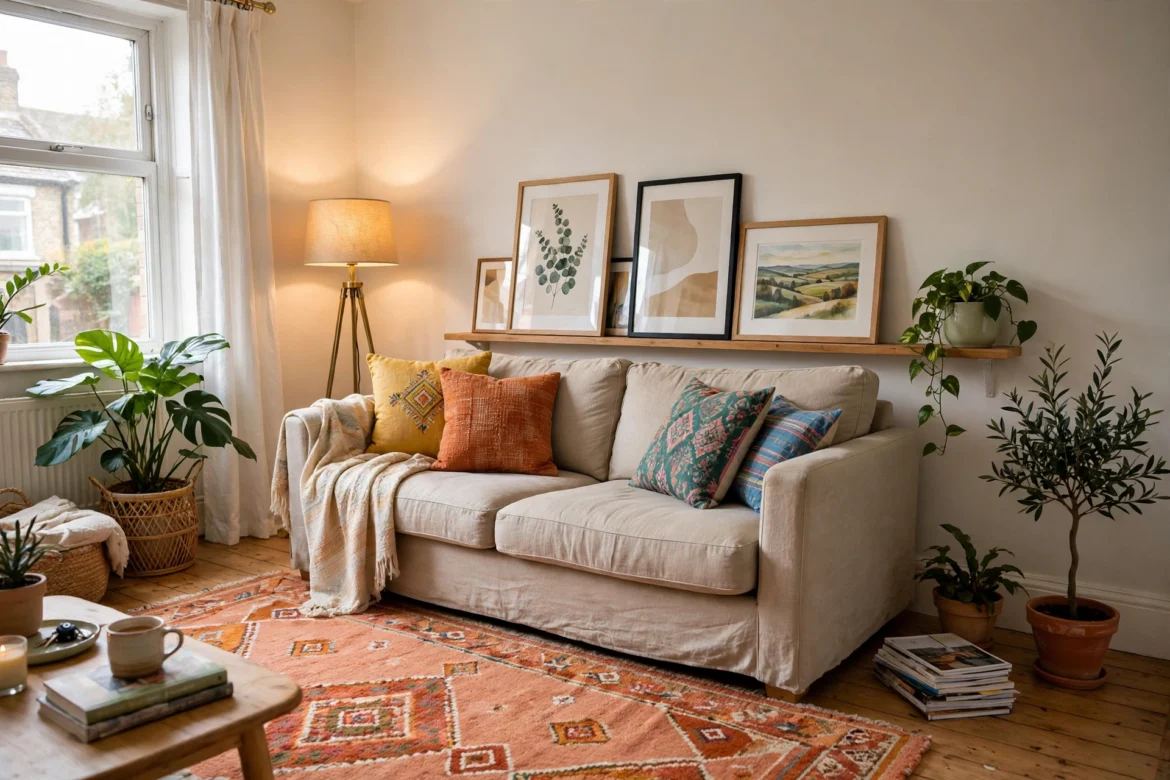
Picture ledges are the next step up, and they are worth considering even though they need fixings. A ledge lets you lean several prints and swap them without new holes each time. That still usually needs screws, so it belongs in the “ask first” category, not the “just do it” category. If permission is refused, lean large frames on furniture or on the floor against the wall instead. A large frame leaning on a sideboard or a chest of drawers looks deliberate, and it moves with you.
Removable wallpaper and wall decals need more caution than their packaging suggests. Removable wallpaper can work well on a smooth, sound, painted wall, but it can lift paint on removal if the paint underneath is old, flaking, or was applied over wallpaper. Test a small piece behind a door for a week before covering a whole wall. In a rental, a single feature wall in removable paper is a safer test than a whole room, and it is much quicker to reverse.
If painting is not allowed, use colour in other layers: a large textile wall hanging, a fabric panel hung from a tension rod, or a gallery of framed prints. A textile adds colour and softens sound, and it comes down in minutes. The same logic applies to mirrors. A large leaning mirror brightens a hallway or a living room and needs no fixings at all, provided it is stable and safe, especially in a home with children or pets.
Finally, photograph every wall before you hang anything, and again after you remove it. Keep the photographs with your check-in inventory. They are your evidence that the wall went back to how it was found.
Floors and Windows: Reversible Layers
Floors in rented homes are often the least loved feature: tired carpet, cold laminate, or tiles you would never have chosen. Replacing them is almost never a renter’s job. Layering over them is.
A large rug is the single most effective reversible floor change. It should be large enough to anchor the furniture, not a small mat floating in the middle of the room. In a living room, the front feet of the sofa and chairs should sit on the rug, with rug showing in front of the sofa. That rule holds whether the rug is over carpet or hard flooring, and it is explained in more detail in our guide to small living room layouts. A rug also protects the floor underneath from furniture marks, which helps at check-out, provided you lift it occasionally and clean underneath.
Layering works on windows too. If the curtains or blinds are landlord’s fixtures, leave them in place and add your own layer. Sheer curtains on a tension rod inside the window recess soften light and add privacy without touching the existing fittings. A tension rod needs no screws, but check that it fits the recess and does not damage the frame, and remove it before you move out. If the existing curtains are dark or heavy, swapping them for your own, and storing the originals safely, is a common arrangement, but only with permission, and only if you can put the originals back exactly as they were. Label the bag, keep all hooks and fittings, and photograph how they were hung.
For draughty windows, secondary glazing film or draught excluder strips that peel off are sometimes used, but treat these as “ask first” items. They can leave residue or pull paint, and window frames are exactly the kind of fitting a check-out report notices. Curtains, rugs, and draught snakes that sit on the floor are the lower risk options.
Kitchen and Bathroom Changes You Can Undo
Kitchens and bathrooms feel the most fixed, and they are where renters often give up. They are also where small, reversible changes pay off, because these are the rooms you use every morning.
In the kitchen, start with what you can lift out. A freestanding storage trolley, a magnetic knife strip that stands on the worktop rather than screwing to the wall, open shelving that stands on the counter, and attractive containers for everyday items all change how the room looks without touching a fixture. If the worktop is stained or worn, a large chopping board, a tray under the kettle and toaster, and a washable runner in front of the sink hide the worst of it and protect it further.
Adhesive tile stickers and removable splashback panels are popular, but they carry the same caution as removable wallpaper. Test one tile in a hidden corner, check how it handles heat and steam near the hob, and be ready to remove it carefully at the end of the tenancy. Never cover damaged tiles or grout with stickers and hope the problem disappears. Report damage to the landlord first, in writing, so it is recorded as pre-existing.
In the bathroom, a new shower curtain, a freestanding over-bath caddy, suction-cup hooks, a freestanding towel ladder, and a washable bath mat change the room completely. Suction cups work best on smooth tiles and glass. They fail on textured tiles and grout lines, so do not rely on them for heavy items. A freestanding storage unit beside the bath or basin is more reliable than a wall cabinet you were not allowed to fit. If the bathroom mirror is small or poorly placed, a freestanding vanity mirror on the basin gives you a second mirror without a fixing.
The rule for both rooms is the same: if a change involves water, heat, gas, or electrics, it is not a reversible decorating change. Leave taps, showers, boilers, and wiring to the landlord. Your job is the layer on top, not the system underneath.
Lighting Without Rewiring
Lighting changes how a rented home feels more than almost any other single change, and it is also one of the easiest to do without rewiring. You do not need to touch a ceiling rose or a light switch to get warm, layered light.
Start with lamps. A floor lamp beside the sofa, a table lamp on a sideboard, and a small lamp in a dark corner give you three pools of light at seating height, which is far more flattering than a single bright ceiling light. Use warm white bulbs throughout, and keep the bulb colour consistent from lamp to lamp, so the wall colour looks the same from one side of the room to the other. Battery-operated or plug-in picture lights, puck lights inside a dark cupboard, and a plug-in strip light under a kitchen wall unit are all reversible, provided you do not damage the surface they stick to. Test adhesive strips on an inconspicuous area first, as with picture strips.
Smart bulbs that screw into existing fittings are another renter-friendly option. They let you change brightness and warmth without changing the fitting, and you simply swap the original bulb back at the end of the tenancy. Keep the original bulbs in a labelled box, so nothing is missing at check-out. The same logic applies to lampshades: if a pendant shade is landlord’s property, do not replace it without permission, but a floor or table lamp with your own shade is entirely yours.
For rooms with little natural light, mirrors and light-coloured textiles do as much as lamps. If your rented room faces north, the colour and lighting advice in our guide to north-facing living room colours explains how warm palettes and layered lamps work together, even when you cannot repaint the walls. The textiles and lamps in that guide are the renter’s version of the same palette.
Furniture and Storage That Moves With You
The best renter’s furniture is furniture that solves a problem in this home and will solve it in the next one too. That means freestanding, modular, and multi-purpose pieces, not built-ins.
A storage ottoman, a sideboard with closed doors, a tall narrow bookcase that fits a dead corner, and a storage bed or under-bed boxes all add storage without fixings. In a small bedroom, freestanding storage is often the only storage you are allowed to add, and our guide to small bedroom storage ideas covers under-bed, over-door, and stackable options that suit a tenancy, because they can all be removed without a trace.
Choose furniture that fits standard UK room sizes, not just this flat. A compact two-seater sofa, 150cm to 180cm wide, a round dining table that seats two to four, and a desk that fits a box room are all easier to move than a corner sofa made for one specific wall. Measure doorways, stairwells, and lift dimensions before you buy a large piece, so moving day does not become a removal problem.
Modular storage earns its keep in a rental. Stackable boxes that fit a wardrobe, a freestanding clothes rail that adds hanging space in a bedroom with no wardrobe, and a kitchen trolley that can become a hallway console in the next home are all worth more than a bespoke unit that only fits one alcove. If you do buy a piece for a specific alcove or corner, measure carefully and accept that it may not fit the next home. That is a cost to weigh before you buy, not after.
Finally, protect the property while you live in it. Felt pads under furniture feet, a mat under a desk chair on a hard floor, coasters and placemats on wooden surfaces, and a tray under plant pots all prevent the marks that become deductions. Prevention is cheaper than repair, and it is entirely in your control.
Room-by-Room Quick Table
Use this table as a starting checklist, then adapt it to your own agreement and rooms.
Living room: adhesive picture strips or leaning art, a large rug, floor and table lamps, cushions and throws, a freestanding bookcase or sideboard. Avoid: new wall fixings, painting, or removing landlord’s curtains without permission.
Bedroom: under-bed storage, over-door hooks, a freestanding clothes rail, a leaning mirror, warm bedding and a rug beside the bed. Avoid: fitted wardrobes, wall-mounted shelves without permission, or painting the walls a different colour.
Kitchen: a storage trolley, countertop organisers, a washable runner, attractive containers, and a tray under small appliances. Avoid: changing taps, tiling, or sticking anything over damaged surfaces without reporting it first.
Bathroom: a new shower curtain, a freestanding towel ladder, suction hooks on smooth tiles, a bath mat, and a freestanding storage unit. Avoid: drilling into tiles, changing the shower or mirror fixings, or covering mould rather than reporting it.
Hallway: a leaning mirror, a slim console or hooks on a freestanding coat stand, a runner rug, and a small lamp if there is a socket. Avoid: wall-mounted coat hooks without permission, or blocking a fire escape route with furniture.
Home office corner: a freestanding desk, a chair mat, a desk lamp, and a small bookcase or trolley for supplies. Avoid: wall-mounted monitor arms or shelving without permission, or trailing cables across a walkway.
Moving-Out Reversal Checklist
Start the reversal a few weeks before you move, not on the last day. Work room by room, and keep the check-in inventory open beside you.
Remove all adhesive strips slowly, following the maker’s instructions, and clean any residue with a method suitable for the wall surface. Take down removable wallpaper or decals, and check the paint underneath in daylight. Fill no holes you did not make, and if you did make a hole with permission, fill and touch it up only as your agreement or landlord directs. Putting the wrong filler or paint on a wall can make a small mark worse.
Put back every original fitting: curtains, blinds, bulbs, shower curtains, and any fixture you swapped with permission. Return furniture to the layout in the inventory photographs, unless the inventory shows the room empty. Clean behind furniture and appliances you moved, and lift rugs to clean underneath. Take dated photographs of every room after you have reversed your changes, including close-ups of walls, floors, and window frames.
Finally, leave the keys, manuals, and any spare fixings where the landlord or agent asks for them, and keep copies of your permission emails, your before photographs, and your after photographs until the deposit is returned. If a deduction is proposed that you disagree with, those records are what a deposit scheme adjudicator will ask to see.
Frequently Asked Questions
Can I hang pictures in a rented home in the UK?
In many tenancies, yes, if you use a reversible method and have permission where your agreement requires it. Adhesive strips are the lowest risk option. Screws and nails usually need written permission, and you should restore the wall before you move out. Always check your own agreement first.
Can my landlord refuse all decorating?
A landlord can refuse permanent alterations, but many agreements allow minor, reversible decoration, and some landlords welcome improvements that are properly reversed. Ask specifically, in writing, for the change you want. A blanket refusal of every reversible change is unusual, but it is not a reason to proceed without permission.
What happens to my deposit if I paint without permission?
Painting without permission can lead to a deduction for repainting, even if the colour looks better to you. The deduction should reflect the cost of returning the room to its original condition, not a full redecoration of the property. Getting written permission before you paint, and agreeing the colour and the reversal, avoids this dispute.
Are command strips safe on all walls?
No. They work best on smooth, sound, painted walls. They are less reliable on textured wallpaper, fresh paint, damp walls, or crumbling plaster. Test one strip first, follow the weight rating, and remove it slowly along the wall. If the paint lifts, stop and report it rather than covering more of the wall.
What is the safest first decorating change in a rental?
Textiles and light. Cushions, throws, a large rug, curtains on a tension rod, and lamps change how a room feels without touching a wall or a fixture. Start there, live with the room for a few weeks, and then decide which reversible wall or storage changes are actually worth asking permission for.