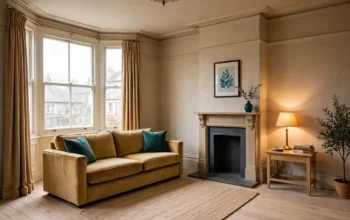
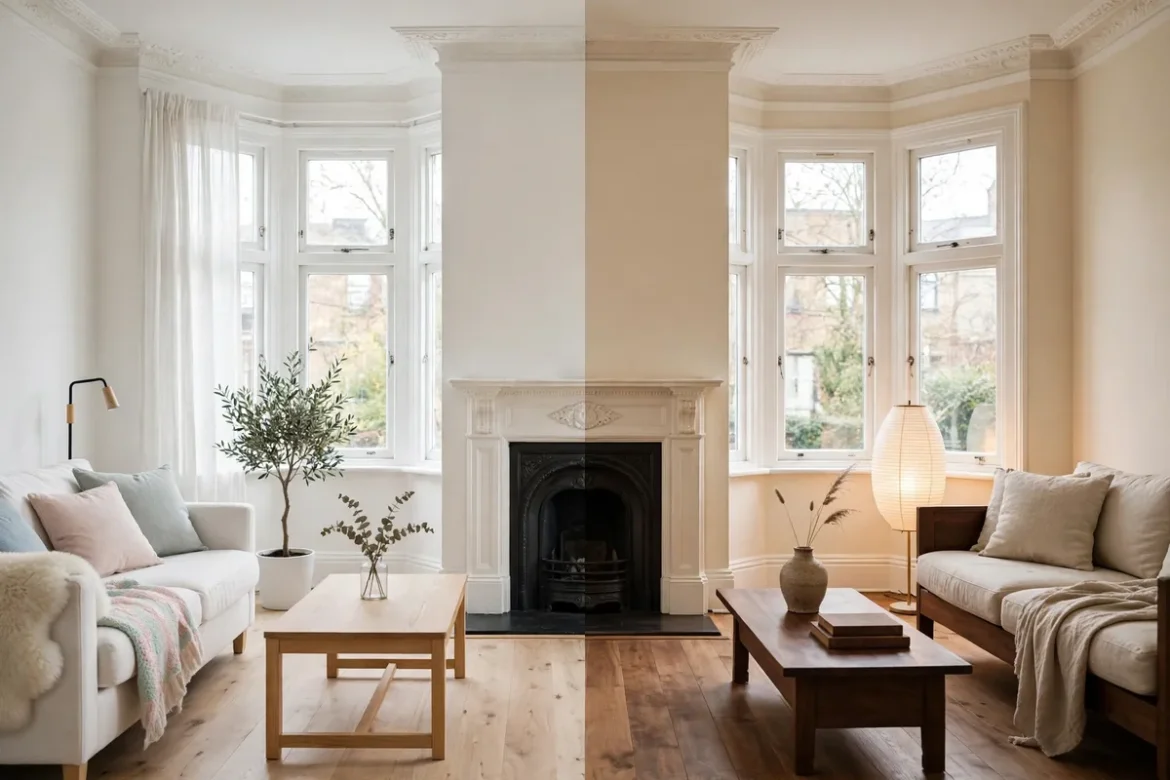
Japandi and Scandinavian design look like the same room at first glance. Pale wood, plain walls, clear surfaces, nothing shouting for attention. Then you live in one for a month and the difference shows up in how the room feels at 4pm on a grey November afternoon, how low the sofa sits, and whether the room invites you to stretch out with friends or to sit quietly with a book.
The confusion is understandable, because Japandi is built from Scandinavian design. It takes the Nordic base, function first, natural materials, uncluttered floors, and adds Japanese restraint: darker contrasts, lower furniture, natural imperfection and more empty space. One sentence covers most of it: a Scandinavian room is bright, white and friendly, while a Japandi room is calmer, warmer and a little more grounded. The rest of this guide works through the differences you can actually see, room by room in a UK home, so you can choose between them, or blend them without ending up with a muddle.
This is a comparison, not a full guide to either style. If you want the whole Japandi method for a living room, our guide to Japandi living room ideas for UK homes covers it in full, including radiators, fireplaces and budgets. If you want the Scandinavian method, our guide to Scandinavian bedroom ideas for UK homes does the same for a bedroom. What follows assumes you know the basics and want to know where the two part company.
The Difference at a Glance
| Scandinavian | Japandi | |
|---|---|---|
| Palette | Bright white walls, pale grey, soft pastels, occasional black accent | Warm cream and oatmeal walls, clay, mocha, olive, charcoal, black as a thin outline |
| Wood tones | Pale woods only: ash, birch, light oak, often whitewashed | Light woods mixed with dark: walnut, smoked oak, blackened frames in the same room |
| Furniture height | Ordinary Western heights, slim tapered legs, deep sink-in sofas | Low silhouettes: platform beds, low-backed sofas, coffee tables you reach down to |
| Light | Maximised: sheer or missing curtains, mirrors, bright surfaces that bounce daylight | Diffused: paper shades, slatted screens, lamps that throw soft shadows |
| Texture | Layered and cosy: sheepskins, knitted throws, candles, framed prints | Tactile and spare: slate, rice paper, handwoven rug, one handmade ceramic |
| Objects | Several, chosen for comfort and use | Very few, each one chosen and given space |
| Feeling | Come in, sit down, stay a while | Breathe, be still, notice this moment |
| Philosophy | Hygge: comfort, warmth and togetherness | Wabi-sabi: the beauty of imperfection and impermanence, softened by Scandinavian comfort |
1. The Palette: White as Canvas, or Warmth as the Whole Picture
This is the fastest way to tell the two apart in a photograph. Scandinavian design builds on white. Walls are white, ceilings are white, and large pieces of furniture are often white or very pale wood. The white reflects the limited daylight of a Nordic winter, and accent colour arrives through textiles: soft grey, muted pastels, a dusty blue cushion, a blush throw.
Japandi rejects white as the dominant colour. Its walls are warm cream, oatmeal or plaster-toned, never brilliant white, and the palette is built from earth tones: clay, sand, warm beige, muted sage, charcoal and terracotta. The difference matters in a UK home because our light is different from Nordic light. A brilliant white wall in a north-facing British living room can turn cold and grey by mid-afternoon, which is why our guide to north-facing living room colours recommends warm whites with a yellow or pink undertone. That warm-white rule sits naturally with Japandi, while a Scandinavian room needs its white to be warm rather than blue-based, plus enough lamps and textiles to stop it feeling stark. Both styles can work in north light, but Japandi forgives a cool room more easily, and Scandinavian rewards a room that already gets decent daylight.
2. Wood Tones: One Pale Family, or Light and Dark Together
Wood is the clearest single tell. A Scandinavian room uses one pale family throughout: ash, birch, light oak or pale pine, kept consistent from the floor to the bedside table. Mixed wood tones are one of the quickest ways to make a calm Scandinavian room look busy, so a darker piece that cannot be replaced is usually painted warm white rather than left to clash.
Japandi deliberately mixes light and dark wood in the same room. A pale oak floor can sit beside a walnut coffee table and blackened window frames, and the contrast is part of the look rather than a mistake. The dark wood is what gives Japandi its grounded feeling, and it is also what makes the style suit period features in British homes: dark walnut and smoked oak sit comfortably against a Victorian fireplace, a chimney breast and original floorboards, where pale Scandinavian wood can look a little washed out against the same features. If your home has dark original woodwork, Japandi will work with it. Scandinavian will ask you to paint it.
3. Furniture Height and Posture: Sink In, or Sit Upright
Scandinavian furniture is casual and comfort-first. Sofas are deep, with room to curl up in, rounded edges and nothing precious about them. A Scandinavian sofa invites a nap. Beds sit at ordinary height on slim legs, and chairs are made for long evenings with friends.
Japandi inherits Japanese formality, so furniture sits lower and straighter. Platform beds sit close to the floor, sofas have low backs and low seats, and coffee tables are low enough that you reach down to them. The lower eye line makes ceilings feel higher and rooms feel calmer, which is a genuine advantage in a British box room or a flat with 2.4 metre ceilings. The trade-off is practical: low furniture is harder to get out of if you have bad knees, and a low sofa with no arms is a poor choice for a family room where people flop down with mugs of tea. Scandinavian comfort wins in a room that is used hard every day. Japandi posture wins in a room where calm matters more than sprawling.
4. Light: Bounce It, or Diffuse It
Both styles were shaped by scarce daylight, but they handle it in opposite ways. Scandinavian design maximises light: sheer curtains or no curtains at all, mirrors on the wall opposite the window, pale floors and bright surfaces that bounce every available bit of daylight around the room. After dark it adds warmth with candles and wool, but the daytime rule is always more light.
Japandi diffuses light instead. Paper lanterns, shoji-style panels and slatted screens soften the light and throw gentle shadows, and the room is comfortable with less of it. In a British home this difference is worth thinking about room by room. A south-facing room with generous windows suits the Scandinavian approach, because there is light to bounce. A north-facing room, or a through-lounge with one small window at each end, often suits Japandi better, because the style does not depend on bright daylight to look right, and its warm palette and low lamps carry the evening. Our 60-30-10 colour rule guide shows how to balance a palette in a real room, and the same proportions work for either style: a dominant calm base, a secondary tone, and a small accent.
5. Texture and Objects: Layered Cosiness, or Edited Restraint
A Scandinavian room is cosy because it is layered: sheepskins over chair backs, knitted throws, candles, framed prints, a few plants, a stack of books. Nothing is precious, and the layers are what make a pale room feel warm rather than bare.
A Japandi room edits that layering down sharply. Fewer objects, each one chosen, and the texture comes from the materials themselves rather than from piling things on: a slate tabletop, a rice-paper shade, a handwoven rug, a ceramic bowl with a visible glaze run. A shelf holds one object, not five. This is the difference most people get wrong in practice. A Japandi room with Scandinavian quantities of cushions, throws and ornaments is not Japandi at all, it is a cluttered Scandinavian room with dark wood. And a Scandinavian room stripped down to one vase and a bare sofa is not Japandi either, it is an unfinished Scandinavian room. The object count is part of the style, not an optional extra.
6. The Philosophy Underneath: Hygge or Wabi-Sabi
Under the surfaces, the two styles want different things from a room. Scandinavian design is rooted in hygge, the Danish idea of cosy contentment, warmth and togetherness. The room is designed to make people feel comfortable and embraced, to gather in, to stay and talk. Japandi is rooted in wabi-sabi, the Japanese appreciation of imperfection, transience and simplicity, softened by Scandinavian comfort. The room is designed to make you feel calm, centred and present, to notice the grain of the wood and the shape of a single bowl rather than the company around the table.
Neither is better. They answer different needs, and most households need both at different times of day. A living room that hosts friends every Friday suits hygge. A bedroom, a reading corner or a home office suits wabi-sabi. That is also why the two styles blend well when the blend is deliberate: take the Scandinavian skeleton, light, function and comfort, and apply Japandi restraint to the palette, the wood tones and the object count, and you get a room that is warm without being busy.
Room by Room in a UK Home
Living room. This is where the choice is most visible. Scandinavian suits a through-lounge that needs to feel bright and sociable, with a deep sofa, pale wood and layered textiles. Japandi suits a living room with a strong fireplace and dark period features, with a low sofa, a walnut coffee table and one good lamp. If the room faces north, lean Japandi for the palette and Scandinavian for the lighting layers, and let the room be a deliberate blend rather than a failed copy of either.
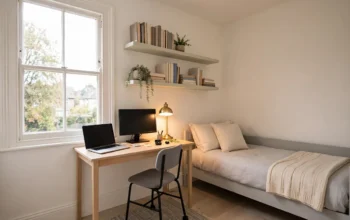
Bedroom. Scandinavian is the safer choice in a small British bedroom, because pale wood and white bedding make a box room feel larger, and the textiles do the warming work. Japandi works in a larger bedroom with a low platform bed, dark wood and warm cream walls, but in a box room the low bed and dark tones can make the room feel smaller unless the light is handled well. Our Scandinavian bedroom guide works through the box-room problem in detail.
Kitchen and dining room. Scandinavian suits most British kitchens, because pale units, light wood and clear worktops make a small kitchen feel bigger and brighter, and the style forgives everyday clutter better than Japandi does. Japandi suits a dining area more than a working kitchen: a low table is impractical for cooking, but a walnut dining table, warm cream walls and a single pendant light make a dining corner feel deliberate and calm.
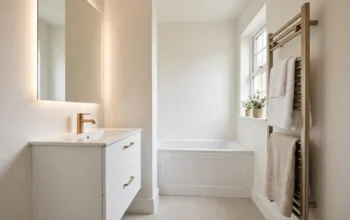
Bathroom. Neither style is a natural fit for a small British bathroom, because both depend on natural materials that dislike steam. Scandinavian wins here on practicality: pale tiles, light wood accessories and white towels are easy to keep clean and make a compact suite feel larger. Japandi can work with warm stone tones, dark wood-look accessories and a single handmade soap dish, but keep the wood away from direct water and choose materials that survive humidity.
Hallway. A narrow Victorian hallway suits Japandi better than most rooms do, because the style’s low, restrained furniture and warm palette flatter a long dark space, and a single mirror and one console table are all the room needs. Scandinavian can make the same hallway feel brighter, but only if the pale walls are warm white rather than brilliant white, and only if the mirror is large enough to bounce the light from the front door.
Which Should You Choose?
Choose Scandinavian if your home is small and dark and you want it to feel bigger and brighter, if the room is used hard by family and friends, if you like layering textiles and living with things around you, and if your woodwork is already pale or painted. It is the more forgiving style for a first attempt, because adding one more cushion or throw rarely breaks it.
Choose Japandi if you want a room that feels calm above all else, if your home has dark period features you want to work with rather than paint over, if the room faces north or gets little direct sun, and if you are comfortable owning fewer things and choosing each one carefully. It is the harder style to maintain, because one cluttered surface breaks the effect, but it is also the style that makes a small British room feel considered rather than cramped.
You can also blend them, and most British homes do, whether they mean to or not. The blend works when you pick one style as the base and borrow from the other in only one or two places. Scandinavian base with a Japandi palette and a walnut coffee table reads as deliberate. Japandi base with a Scandinavian deep sofa and a sheepskin reads as comfortable. What does not work is borrowing half of each: pale walls and dark walls in the same room, low furniture and high furniture side by side, one shelf edited to a single vase and the next shelf piled with ornaments. Pick a base, borrow sparingly, and let one style lead.
Frequently Asked Questions
Is Japandi just Scandinavian with darker wood?
No, although darker wood is the most visible difference. Japandi also lowers the furniture, edits the objects down sharply, diffuses the light rather than maximising it, and replaces the Scandinavian aim of cosy togetherness with a quieter aim of stillness. Dark wood on its own, in a room that is otherwise fully Scandinavian, is just a Scandinavian room with a dark table.
Can I mix Japandi and Scandinavian in the same house?
Yes, and it often works better than mixing them in the same room. A Scandinavian living room and a Japandi bedroom, or a Scandinavian kitchen and a Japandi hallway, give each style a room where it can be itself. The shared base of natural materials and pale-to-warm neutrals keeps the house feeling connected, and the change of mood from room to room feels intentional rather than confused.
Which style is cheaper?
Neither is inherently cheaper, because both depend on buying fewer, better pieces rather than filling a room quickly. Scandinavian can cost less in practice, because pale painted furniture, linen-look textiles and second-hand light wood pieces are easy to find, and the style tolerates a mix of old and new. Japandi costs more when it is done properly, because its few pieces need to be good quality: a badly made low table in cheap dark wood looks worse than no table at all. In both styles, buying one good piece a month beats buying a whole room in a weekend.
Which style suits a rented home?
Scandinavian suits renting better. Its pale palette works over magnolia walls, its textiles and mirrors do the warming work without paint, and its furniture is ordinary height and easy to move. Japandi is harder in a rental, because its warm cream walls and dark wood tones usually need paint and new furniture, and a landlord’s pale carpet will fight the earthy palette. If you rent and love Japandi, borrow its restraint and its low lamp light, and keep the Scandinavian pale base.
Do I need to redecorate the whole room to switch styles?
No. The palette and the wood tones do most of the work, so a switch can start with the textiles and the largest piece of furniture. Changing cushion covers, a throw and a rug from pastels to clay and oatmeal, and swapping a pale coffee table for a walnut one, moves a room a long way towards Japandi. Going the other way, pale linen, a sheepskin and a mirror move a Japandi room towards Scandinavian. Repainting the walls is the last step, not the first, because it is the hardest to undo if the new style does not suit the light.